Mental Health, Patient Resources Rebecca Sommer Mental Health, Patient Resources Rebecca Sommer

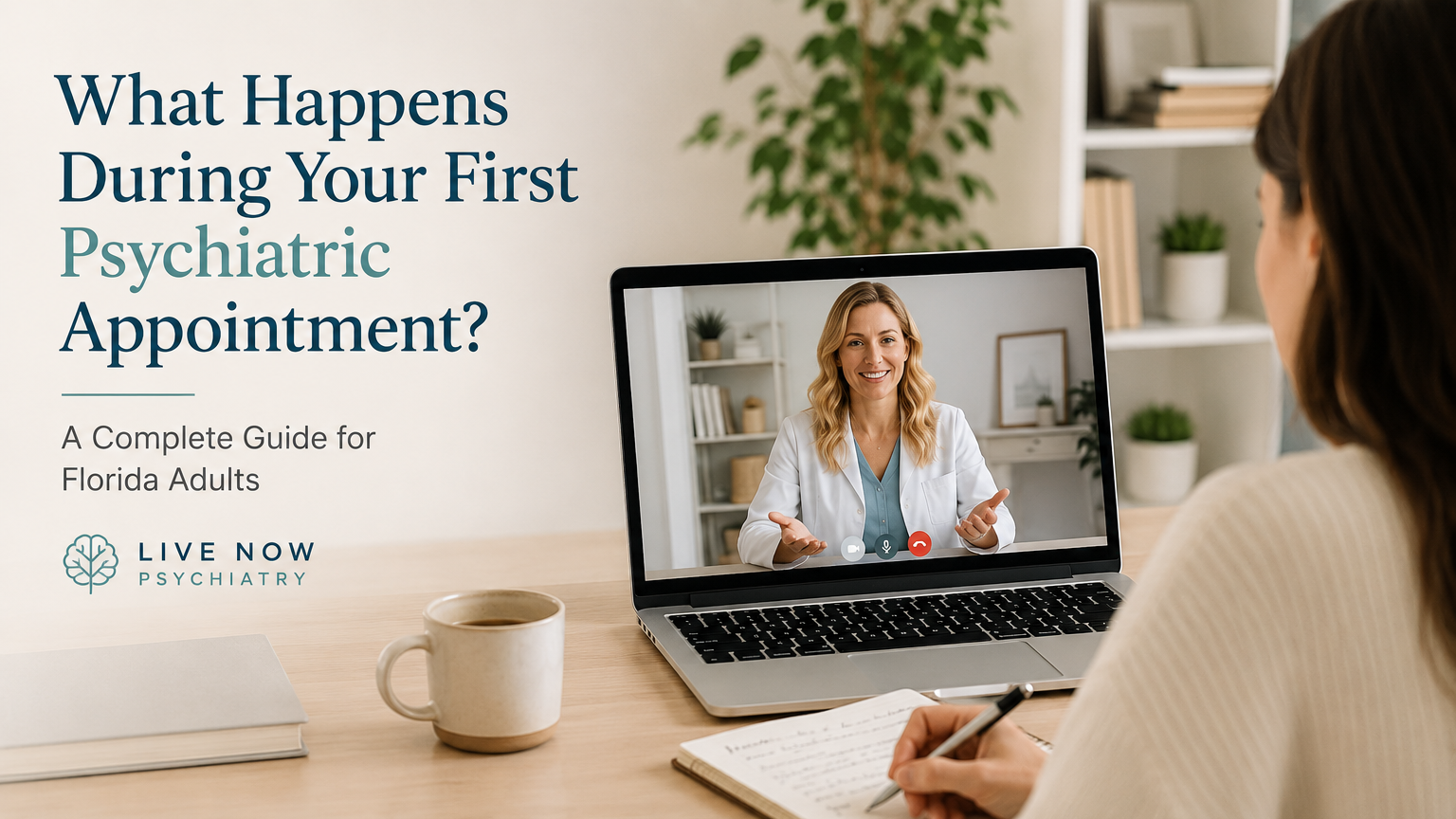
What Happens During Your First Psychiatric Appointment? A Complete Guide for Florida Adults

Preparing for your first psychiatric appointment? Learn what happens during a psychiatric evaluation, the questions your provider may ask, whether medication is prescribed, and how online psychiatric care helps adults across Florida receive compassionate, evidence-based treatment.
Taking the first step toward improving your mental health can feel overwhelming. If you've never seen a psychiatric provider before, you may wonder what will happen during your appointment, what questions will be asked, whether medication will be prescribed, or if you'll be judged for talking about your struggles.

The good news is that your first psychiatric appointment is simply a conversation designed to understand your symptoms, medical history, and goals so that your provider can recommend the safest and most effective treatment plan. Whether you're experiencing anxiety, depression, ADHD, insomnia, PTSD, or another mental health concern, your provider's goal is to listen, understand, and help.

At Live Now Psychiatry, we provide compassionate, evidence-based online psychiatric care for adults throughout Florida. We understand that reaching out for help isn't always easy, and we're committed to making the process as comfortable and stress-free as possible.

Looking for virtual psychiatric care?

Learn more about our online services.

Why Do So Many People Delay Seeing a Psychiatric Provider?

Many adults wait months—or even years—before scheduling their first psychiatric appointment. Some hope their symptoms will improve on their own, while others worry about being judged or receiving a mental health diagnosis.

These concerns are incredibly common, but they often prevent people from getting treatment that could significantly improve their quality of life.

Mental health conditions are medical conditions—just like asthma, diabetes, or high blood pressure. Seeking treatment is not a sign of weakness. It's a proactive step toward improving your health and overall well-being.

Many patients tell us they wish they had sought help sooner after realizing how much better they felt with proper treatment.

Common Reasons Adults Schedule Their First Psychiatric Appointment

Every patient has a unique story, but some of the most common reasons adults seek psychiatric care include:

  • Persistent anxiety or excessive worrying

  • Depression or loss of motivation

  • Difficulty focusing or concentrating

  • Suspected ADHD

  • Panic attacks

  • Trouble sleeping

  • Mood changes

  • Work-related stress

  • Relationship difficulties

  • Trauma or PTSD symptoms

  • Burnout

  • Feeling overwhelmed by everyday responsibilities

Many patients experience more than one of these concerns at the same time.

Learn more about anxiety treatment.(Link to: Anxiety Treatment in Florida)

Learn more about depression treatment.(Link to: Depression Treatment in Florida)

Learn more about adult ADHD evaluations.(Link to: Adult ADHD Evaluation in Florida)

What Is the Purpose of a Psychiatric Evaluation?

Many people assume a psychiatric appointment is simply about getting medication.

In reality, medication is only one possible treatment option.

The primary goal of your first psychiatric appointment is to understand you as a whole person. Your provider wants to learn about your symptoms, medical history, family history, lifestyle, stressors, previous treatments, and treatment goals.

Every treatment plan is individualized because no two patients experience mental health conditions the same way.

For some people, medication may be appropriate.

For others, psychotherapy, lifestyle modifications, sleep improvements, stress management, or additional diagnostic evaluation may be recommended instead.

A thorough psychiatric evaluation allows your provider to make evidence-based recommendations that prioritize both safety and effectiveness.

What Happens During Your First Appointment?

Most first appointments last between 45 and 60 minutes, allowing enough time to understand your concerns without feeling rushed.

During your appointment, your provider will spend time getting to know you, asking questions, and answering any questions you may have.

Rather than feeling like an interview, most patients describe the appointment as a relaxed conversation focused on understanding what's been happening in their lives.

What Questions Will My Psychiatric Provider Ask?

Although every evaluation is personalized, your provider will likely ask questions about several important areas.

Your Current Symptoms

Your provider may begin with questions such as:

  • What brought you in today?

  • When did your symptoms begin?

  • Have they gradually worsened or started suddenly?

  • How are your symptoms affecting work, school, or relationships?

  • What have you already tried to help yourself?

  • What concerns you the most?

These questions help your provider understand how your symptoms affect your daily functioning.

Mood Symptoms

If you're experiencing depression or mood changes, your provider may ask about:

  • Feeling sad or emotionally numb

  • Loss of interest in activities

  • Low motivation

  • Feelings of guilt

  • Hopelessness

  • Changes in energy

  • Crying spells

  • Irritability

  • Mood swings

Understanding these symptoms helps determine whether they meet criteria for depression or another mood disorder.

Anxiety Symptoms

Anxiety is one of the most common reasons adults seek psychiatric care.

Your provider may ask:

  • Do you worry excessively?

  • Do you feel anxious most days?

  • Have you experienced panic attacks?

  • Do you avoid certain situations?

  • Does anxiety interfere with work or relationships?

  • Do you experience racing thoughts?

  • Does anxiety affect your sleep?

Physical symptoms of anxiety are also important.

These may include:

  • Rapid heartbeat

  • Sweating

  • Trembling

  • Chest tightness

  • Shortness of breath

  • Upset stomach

  • Muscle tension

  • Dizziness

Many people are surprised to learn that anxiety can cause very real physical symptoms.

Attention and Concentration

If ADHD is suspected, your provider will ask detailed questions about your attention, organization, and executive functioning.

Questions may include:

  • Do you frequently lose important items?

  • Is it difficult to stay organized?

  • Do you procrastinate?

  • Are you easily distracted?

  • Do you interrupt conversations?

  • Do you struggle to finish projects?

  • Did these symptoms begin during childhood?

  • Have they affected school, work, or relationships?

Because ADHD is considered a neurodevelopmental condition, understanding childhood symptoms is an important part of the evaluation.

Read more about ADHD evaluations.

Learn about treatment options for adult ADHD.

Sleep

Sleep plays an important role in nearly every mental health condition.

Poor sleep can contribute to:

  • Anxiety

  • Depression

  • Difficulty concentrating

  • Irritability

  • Fatigue

  • Memory problems

Your provider may ask:

  • What time do you usually go to bed?

  • How long does it take you to fall asleep?

  • Do you wake during the night?

  • How many hours do you typically sleep?

  • Do you feel rested when you wake up?

  • Do you snore?

  • Do you use sleep medications?

Improving sleep alone can sometimes significantly improve overall mental health.

Learn more about insomnia treatment.

Trauma History

If appropriate, your provider may ask whether you've experienced traumatic events that continue to affect your daily life.

You are never required to discuss details before you're comfortable.

Your provider may ask whether you experience:

  • Nightmares

  • Flashbacks

  • Hypervigilance

  • Avoidance

  • Emotional numbness

  • Easily being startled

  • Difficulty trusting others

These questions help determine whether trauma-focused treatment may be beneficial.

Learn more about PTSD treatment.

Medical History

Your mental health and physical health are closely connected. During your first psychiatric appointment, your provider will review your medical history to identify any health conditions that may be contributing to your symptoms or influence treatment decisions.

Common topics include:

  • High blood pressure

  • Heart disease

  • Diabetes

  • Thyroid disorders

  • Asthma

  • Chronic pain

  • Neurological conditions

  • Sleep apnea

  • Previous surgeries

  • Pregnancy or family planning, when appropriate

Certain medical conditions can cause symptoms that resemble anxiety, depression, or ADHD. Understanding your overall health helps ensure your treatment plan is both safe and effective.

Current Medications and Supplements

One of the most important parts of your evaluation is reviewing everything you currently take, including prescription medications, over-the-counter medications, vitamins, herbal supplements, and natural products.

Even medications prescribed for non-psychiatric conditions can affect mood, sleep, anxiety, or concentration.

Examples include:

  • Blood pressure medications

  • Steroids

  • Thyroid medications

  • Birth control

  • Pain medications

  • Sleep aids

  • Allergy medications

  • Energy supplements

  • Weight-loss medications

This review also helps identify possible medication interactions if treatment is recommended.

Previous Mental Health Treatment

Your provider will ask about any previous mental health treatment, including:

  • Previous psychiatric diagnoses

  • Counseling or psychotherapy

  • Hospitalizations

  • Emergency room visits

  • Previous psychiatric medications

  • Medication effectiveness

  • Medication side effects

If you've taken medication before, your provider will likely ask questions such as:

  • Did it help?

  • How long did you take it?

  • Did you experience side effects?

  • Why was it discontinued?

This information helps avoid repeating treatments that were ineffective and guides future recommendations.

Family Mental Health History

Many psychiatric conditions have a genetic component.

Your provider may ask whether close family members have experienced:

  • Depression

  • Anxiety disorders

  • ADHD

  • Bipolar disorder

  • PTSD

  • Substance use disorders

  • Schizophrenia

  • Suicide attempts

This information does not determine whether you have a condition, but it provides valuable context during the evaluation.

Lifestyle Habits

Mental health is influenced by many aspects of daily life.

Your provider may ask about:

  • Exercise

  • Nutrition

  • Work schedule

  • Relationships

  • Major life stressors

  • Caffeine intake

  • Alcohol use

  • Nicotine use

  • Recreational drug use

These questions are not meant to judge you. They help identify factors that may be affecting your emotional well-being and help create the most effective treatment plan.

Will My Provider Ask About Alcohol or Drug Use?

Yes.

This is a routine part of every psychiatric evaluation.

Your provider may ask about:

  • Alcohol

  • Marijuana

  • Nicotine

  • Vaping

  • Prescription medications

  • Illicit substances

These questions help ensure medications can be prescribed safely and help identify whether substance use may be contributing to your symptoms.

Honest answers allow your provider to recommend the safest treatment options.

Will I Be Asked About Suicide or Self-Harm?

Many people feel nervous when asked these questions, but they are a standard part of every comprehensive psychiatric evaluation.

Your provider may ask whether you've experienced:

  • Thoughts of death

  • Thoughts of self-harm

  • Suicidal thoughts

  • Previous suicide attempts

  • Thoughts of harming others

These questions are asked because your safety is always the highest priority.

Answering honestly allows your provider to determine the most appropriate level of care and provide support if needed.

If you are experiencing thoughts of harming yourself or someone else, seek immediate emergency assistance by calling 911 or going to your nearest emergency department.

Will I Need Laboratory Testing?

Not everyone requires laboratory testing.

However, depending on your symptoms, medical history, and treatment plan, your provider may recommend laboratory studies to rule out medical conditions that can mimic psychiatric disorders.

Examples may include:

  • Thyroid function tests

  • Complete blood count (CBC)

  • Comprehensive metabolic panel (CMP)

  • Vitamin B12

  • Vitamin D

  • Iron studies

  • Blood sugar testing

  • Lipid panel

These tests help ensure that underlying medical conditions are not contributing to your symptoms.

Will Medication Be Prescribed During My First Appointment?

This is one of the most frequently asked questions.

The answer depends on your individual situation.

If your provider determines that medication is appropriate after completing a comprehensive psychiatric evaluation, treatment options may be discussed during your first appointment.

However, medication is not recommended for every patient.

Some individuals may benefit more from:

  • Psychotherapy

  • Lifestyle changes

  • Sleep improvement

  • Stress management

  • Additional evaluation

  • Coordination with other healthcare providers

Treatment decisions are individualized and based on current medical evidence, safety considerations, your symptoms, and your treatment goals.

Will Controlled Medications Be Prescribed?

Controlled medications are not appropriate for every patient and are prescribed only when medically indicated after a comprehensive psychiatric evaluation.

Not every patient is a candidate for stimulant medications, benzodiazepines, or other controlled substances.

Your provider will carefully review your medical history, psychiatric history, previous treatments, current medications, safety considerations, and applicable state and federal regulations before determining whether these medications are appropriate.

Treatment recommendations are always individualized and based on clinical judgment, patient safety, and current standards of care.

What If I Don't Need Medication?

Many patients are surprised to learn that medication is only one component of mental health treatment.

Depending on your situation, your provider may recommend:

  • Individual psychotherapy

  • Cognitive Behavioral Therapy (CBT)

  • Stress reduction techniques

  • Sleep hygiene improvements

  • Exercise

  • Mindfulness practices

  • Follow-up monitoring

  • Additional diagnostic testing

For many patients, combining medication with psychotherapy produces the best long-term outcomes.

Learn more about our approach to online psychiatric care.(Link to: Online Psychiatric Care in Florida)

How Should I Prepare for My Appointment?

Preparing before your appointment helps you get the most out of your visit.

Consider bringing:

  • A list of current medications

  • Previous psychiatric records, if available

  • A list of medical conditions

  • Questions you would like answered

  • Insurance information, if applicable

  • Recent laboratory results, if available

It may also be helpful to write down your symptoms before your appointment so you don't forget anything important during your discussion.

What Happens After My First Psychiatric Appointment?

At the end of your evaluation, your psychiatric provider will review their impressions and discuss personalized treatment recommendations.

Depending on your individual needs, your treatment plan may include:

  • Medication management

  • Individual psychotherapy recommendations

  • Lifestyle modifications

  • Sleep improvement strategies

  • Stress management techniques

  • Laboratory testing, if indicated

  • Referral to another healthcare professional when appropriate

  • Follow-up appointments to monitor your progress

Mental health treatment is a collaborative process. You should feel comfortable asking questions, discussing concerns, and actively participating in your treatment decisions.

How Often Will I Need Follow-Up Appointments?

The frequency of follow-up appointments depends on your diagnosis, symptoms, treatment plan, and whether medications are prescribed.

Generally, patients beginning a new medication are seen more frequently to monitor effectiveness, side effects, and determine whether adjustments are needed.

Once symptoms are stable, appointments may become less frequent depending on your individual treatment plan.

Your provider will discuss an appropriate follow-up schedule during your visit.

Can My Appointment Be Done Online?

Yes.

Telepsychiatry has become a convenient, secure, and effective way for many adults to receive high-quality mental health care from the comfort of home.

During a virtual psychiatric appointment, your provider conducts the same comprehensive psychiatric evaluation that would typically occur during an in-person visit.

You'll discuss your symptoms, medical history, previous treatments, and goals while meeting through a secure HIPAA-compliant video platform.

Many patients appreciate the convenience of online psychiatric care because it eliminates travel time, reduces missed work, and allows them to receive treatment from a familiar environment.

Learn more about our telehealth services.(Link to: Online Psychiatric Care in Florida)

Should I Be Honest During My Appointment?

Absolutely.

Your psychiatric provider is not there to judge you.

The more honest and open you are, the better your provider can understand your symptoms and develop an individualized treatment plan.

Many patients worry about discussing topics such as:

  • Anxiety

  • Depression

  • Trauma

  • Panic attacks

  • Difficulty concentrating

  • Relationship struggles

  • Alcohol use

  • Marijuana use

  • Sleep problems

  • Past treatment experiences

These conversations are a routine part of psychiatric care.

Honesty allows your provider to make the safest and most effective recommendations based on your individual circumstances.

Common Misconceptions About Seeing a Psychiatric Provider

"Only people with severe mental illness need psychiatric care."

False.

Many patients seek treatment for mild to moderate anxiety, depression, ADHD, insomnia, stress, or life transitions. Early treatment often leads to better outcomes.

"I'll automatically be prescribed medication."

False.

Medication is only one treatment option.

Some patients benefit from therapy alone, while others benefit from medication, psychotherapy, lifestyle changes, or a combination of treatments.

Every recommendation is individualized.

"My provider will judge me."

False.

Psychiatric providers speak with people from every background and every stage of life.

The goal is to understand your experiences—not to judge them.

"My symptoms aren't bad enough."

Many people delay treatment because they believe someone else has it worse.

If your symptoms are affecting your relationships, work, sleep, or quality of life, seeking professional help is appropriate.

You don't need to wait until you're in crisis to benefit from psychiatric care.

When Should You Consider Scheduling a Psychiatric Evaluation?

You may benefit from a psychiatric evaluation if you have been experiencing:

  • Persistent anxiety

  • Frequent worrying

  • Panic attacks

  • Ongoing depression

  • Difficulty concentrating

  • Suspected ADHD

  • Trouble sleeping

  • Mood changes

  • Trauma-related symptoms

  • Emotional exhaustion

  • Loss of motivation

  • Difficulty functioning at work, school, or home

Seeking treatment early can often improve symptoms before they become more severe.

Frequently Asked Questions

How long does a psychiatric evaluation take?

Most initial psychiatric evaluations last approximately 45 to 60 minutes, allowing enough time for your provider to obtain a comprehensive understanding of your concerns.

Will I receive a diagnosis during my first appointment?

Depending on the information gathered during your evaluation, your provider may discuss diagnostic impressions. In some situations, additional information or follow-up visits may be necessary before confirming a diagnosis.

Do I need a referral to see a psychiatric provider?

Many patients can schedule an appointment directly without a referral. Requirements may vary depending on your insurance plan if applicable.

Can online psychiatry treat anxiety, depression, ADHD, and insomnia?

Yes. Many common mental health conditions can be effectively evaluated and managed through secure telepsychiatry when clinically appropriate.

Learn more about anxiety treatment.

Learn more about depression treatment.

Learn more about adult ADHD treatment.

Learn more about insomnia treatment.

What if medication isn't right for me?

Medication is only one possible treatment option. Your provider will discuss recommendations based on your symptoms, preferences, medical history, and current evidence-based guidelines.

Take the First Step Toward Better Mental Health

Scheduling your first psychiatric appointment doesn't mean something is "wrong" with you—it means you're taking an important step toward understanding your mental health and improving your quality of life.

Whether you're experiencing anxiety, depression, ADHD, insomnia, or another mental health concern, seeking professional evaluation can provide clarity, support, and personalized treatment recommendations.

At Live Now Psychiatry, we proudly provide compassionate online psychiatric care for adults throughout Florida. Our goal is to create a welcoming, judgment-free environment where patients feel heard, respected, and empowered to improve their mental health.

Ready to get started? Schedule your appointment today.


Read More
Rebecca Sommer Rebecca Sommer

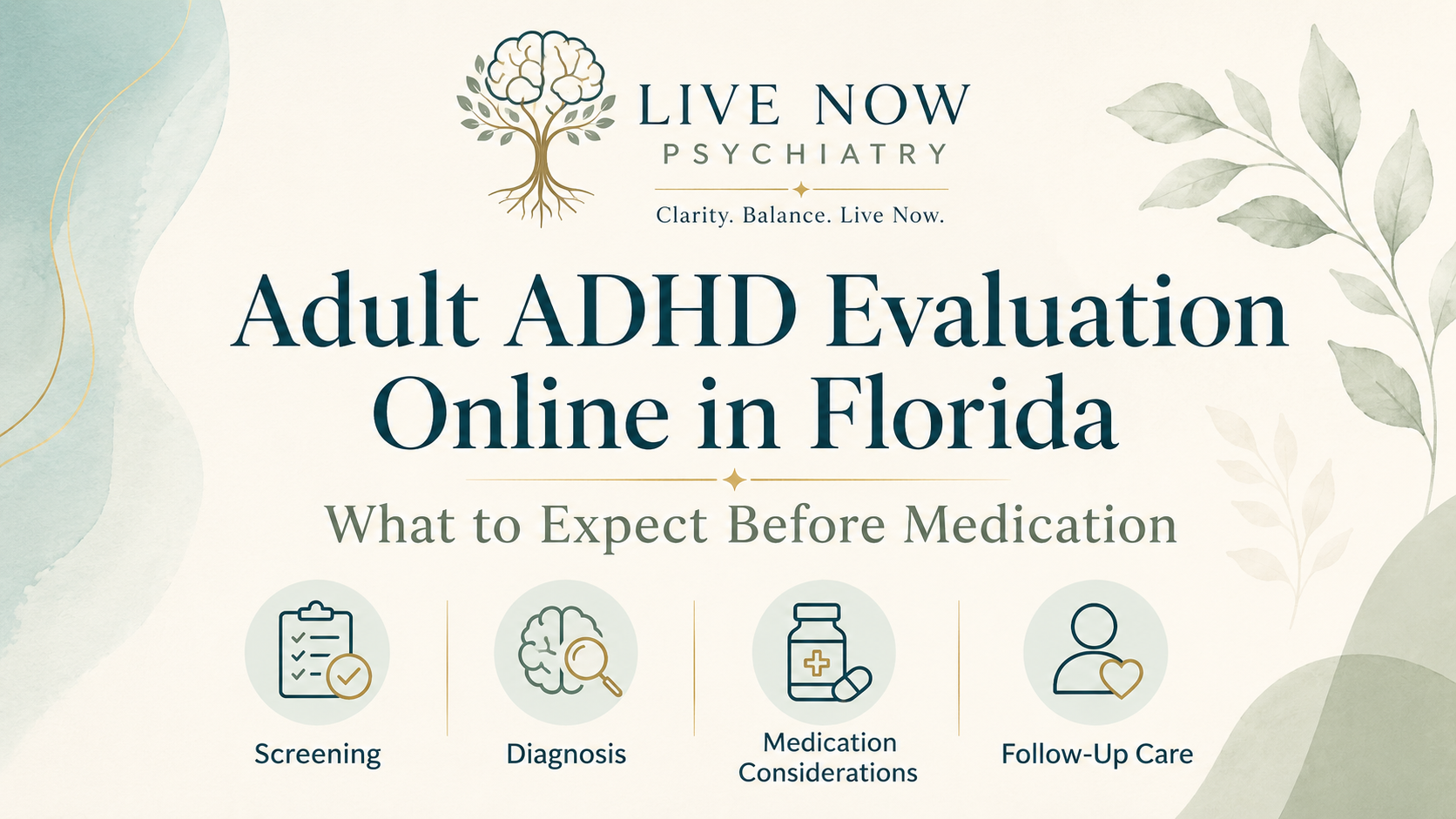
Adult ADHD Evaluation Online in Florida: What to Expect Before Medication

Wondering if adult ADHD may be affecting your focus, organization, motivation, or daily life? Learn what to expect during an online ADHD evaluation in Florida, including screening, diagnosis, medication considerations, and follow-up care with Live Now Psychiatry.

If you are an adult in Florida wondering whether you may have ADHD, you may feel frustrated, overwhelmed, or unsure where to start. Many adults reach out for help after years of struggling with focus, procrastination, time management, organization, distractibility, motivation, or feeling mentally scattered.

At Live Now Psychiatry, adults in Florida can receive online psychiatric care in Florida through secure telehealth. An ADHD evaluation can help clarify whether your symptoms may be related to ADHD, anxiety, depression, insomnia, trauma, life stress, or another mental health concern.

This article explains what to expect during an online ADHD evaluation, what information may be reviewed, how medication is considered, and when it may be appropriate to book a free 15-minute ADHD screening.

Adult ADHD Is Often Missed

Many adults with ADHD were never diagnosed as children. Some were told they were smart but not applying themselves. Others learned how to compensate for years but began struggling more when life became more demanding.

Adult ADHD may become more noticeable during college, graduate school, career changes, relationship stress, parenting responsibilities, divorce, or other major life transitions. For some adults, symptoms have always been present, but they only become overwhelming when responsibilities increase.

Adults often seek an ADHD evaluation because they feel like they are working harder than everyone else just to keep up.

Common Reasons Adults Seek an ADHD Evaluation

Adults may wonder about ADHD when they repeatedly struggle with attention, organization, time, and follow-through. These symptoms can affect work, school, relationships, finances, self-esteem, and daily routines.

Common concerns may include difficulty starting tasks, trouble finishing projects, procrastination, poor time management, forgetfulness, losing items often, difficulty staying organized, trouble paying attention during conversations, mental restlessness, interrupting, impulsive decisions, emotional frustration, and feeling overwhelmed by ordinary responsibilities.

Some adults describe having many ideas but difficulty completing them. Others feel embarrassed because they miss deadlines, run late, avoid paperwork, or feel unable to stay consistent even when they care deeply.

If these patterns are affecting your daily life, an ADHD evaluation may help determine what is going on.

Can ADHD Be Evaluated Online in Florida?

Yes, ADHD symptoms can often be evaluated through telehealth when clinically appropriate. Online care can be especially helpful for adults who need privacy, flexible scheduling, or access to care without traveling to an office.

At Live Now Psychiatry, appointments are available for adults located in Florida. Care is provided through a secure telehealth setting. The goal is to better understand your symptoms, history, functioning, and treatment needs.

Online ADHD care may include evaluation, education, treatment planning, medication management, and follow-up care when clinically appropriate. For adults looking for ADHD treatment for adults in Florida, telehealth may be a convenient first step.

What Happens During an Adult ADHD Evaluation?

An adult ADHD evaluation is more than simply saying you have trouble focusing. A psychiatric provider will usually ask about your symptoms, when they started, how long they have been present, and how they affect your life.

During the evaluation, your provider may review your current symptoms, childhood history, school or work functioning, daily habits, sleep patterns, anxiety symptoms, depression symptoms, trauma history when relevant, substance use history, medical history, current medications, supplements, past psychiatric treatment, prior ADHD diagnosis, prior medication history, and family history when relevant.

This helps determine whether ADHD is likely, whether another condition may better explain the symptoms, or whether more than one issue may be present.

ADHD vs Anxiety, Depression, Insomnia, and Stress

Focus problems do not always mean ADHD. Anxiety can make it hard to concentrate because the mind is busy worrying. Depression can cause low motivation, slowed thinking, fatigue, and difficulty completing tasks. Insomnia can make attention, memory, and emotional regulation worse. Trauma and chronic stress can also affect focus.

Some adults have ADHD and another condition at the same time. Others may initially think they have ADHD when anxiety, depression, or sleep problems are the main concern.

This is why it is important to understand ADHD vs anxiety before starting medication. If anxiety appears to be a major concern, anxiety treatment in Florida may also be part of the treatment discussion. If low mood, low motivation, or hopelessness are present, depression treatment in Florida may also be considered. If poor sleep is contributing to concentration problems, insomnia treatment may be an important part of care.

What If You Were Diagnosed With ADHD Before?

If you were previously diagnosed with ADHD, it can be helpful to share any past records, medication history, pharmacy history, or previous treatment details. A prior diagnosis does not automatically mean the same treatment is appropriate now, but it can help guide the evaluation.

Your provider may ask when you were diagnosed, who diagnosed you, what symptoms were present, what medications you tried, what helped, what caused side effects, and why treatment stopped.

Your provider may also ask whether there were any concerns with blood pressure, heart rate, anxiety, sleep, appetite, mood, medication misuse, or other safety issues. This information helps create a safer and more personalized treatment plan.

Will ADHD Medication Be Prescribed at the First Appointment?

Medication may be considered when clinically appropriate, but it is not automatic. The decision depends on the evaluation, your symptoms, medical history, psychiatric history, current medications, risks, prior treatment, and whether ADHD appears to be the right diagnosis.

Some patients may be appropriate candidates for ADHD medication management. Others may benefit from treating anxiety, depression, insomnia, trauma, or another concern first. Some may need additional records, follow-up, or medical clearance before medication is prescribed.

The goal is not simply to prescribe medication. The goal is to choose a treatment plan that is safe, appropriate, and helpful.

ADHD Medication Options for Adults

ADHD medication options may include stimulant and non-stimulant medications. Stimulants include amphetamine-based and methylphenidate-based options. Non-stimulant options may also be considered depending on symptoms, medical history, side effects, anxiety, sleep, blood pressure, patient preference, and clinical appropriateness.

Some adults ask specifically about Adderall or Vyvanse, but those are not the only options. ADHD treatment may involve different medication classes, dose adjustments, lifestyle strategies, therapy support, and ongoing follow-up.

If you are interested in learning more, you can read about ADHD medication options besides Adderall and Vyvanse.

Why Follow-Up Matters With ADHD Medication

If ADHD medication is prescribed, follow-up care is important. ADHD medications can affect focus, appetite, sleep, heart rate, blood pressure, mood, and anxiety. Follow-up visits help monitor whether the medication is helping, whether the dose is appropriate, and whether side effects are present.

Follow-up may include discussion of how long the medication lasts, whether focus has improved, sleep quality, appetite changes, anxiety or mood changes, blood pressure or heart rate concerns, work or school functioning, side effects, and whether medication changes are needed.

ADHD treatment is often an ongoing process. The first step is evaluation. The next step is monitoring and adjusting the plan when needed.

Online ADHD Care for Adults Across Florida

Online ADHD care can be convenient for adults who are busy, working, in school, managing family responsibilities, or living in areas where in-person psychiatric appointments are limited.

Telehealth may make it easier to attend appointments from home, schedule care around work or school, discuss symptoms privately, avoid travel time, continue consistent follow-up, and receive care from anywhere in Florida.

Live Now Psychiatry serves adults across Florida, including Miami, Fort Lauderdale, Boca Raton, Delray Beach, West Palm Beach, Orlando, Tampa, Jacksonville, Sarasota, Naples, Port St. Lucie, Tallahassee, and other Florida communities through secure telehealth.

Who May Be a Good Fit for Live Now Psychiatry?

Live Now Psychiatry provides online psychiatric care for adults in Florida. ADHD care may be a good fit if you are an adult experiencing symptoms of inattention, disorganization, procrastination, distractibility, restlessness, difficulty completing tasks, or difficulty managing daily responsibilities.

Care may also be helpful if you are unsure whether symptoms are related to ADHD, anxiety, depression, insomnia, trauma, or life stress.

Live Now Psychiatry is not an emergency or crisis service. If you are having thoughts of harming yourself or others, call 911, go to the nearest emergency room, or call or text 988 for immediate crisis support.

When to Book a Free ADHD Screening

A free 15-minute ADHD screening can help determine whether Live Now Psychiatry may be an appropriate fit for your needs. The screening is not a full evaluation and does not guarantee diagnosis, treatment, or medication. It is a brief first step to help decide whether scheduling a full appointment makes sense.

You may consider booking a screening if you are an adult located in Florida, have ongoing focus or organization problems, wonder whether you may have ADHD, want to understand whether online care may be appropriate, are interested in psychiatric evaluation or medication management, or want care from a psychiatric nurse practitioner through telehealth.

Start With an Online ADHD Screening in Florida

If ADHD symptoms are affecting your work, school, relationships, or daily life, you do not have to keep trying to manage everything alone. An online ADHD evaluation can help clarify what may be going on and what treatment options may be appropriate.

Live Now Psychiatry offers online psychiatric care in Florida for adults, including ADHD evaluation and medication management when clinically appropriate.

Book a free 15-minute ADHD screening to take the first step.

Read More

ADHD Medication Options Besides Adderall & Vyvanse | Florida ADHD Treatment

Learn about ADHD medication options besides Adderall and Vyvanse, including methylphenidate, nonstimulant ADHD medications, and other treatment options for adults in Florida seeking online psychiatric care.

ADHD Medication Options Besides Amphetamines

When people think about ADHD medication, they often think of amphetamine-based stimulants such as Adderall or Vyvanse. While these medications can be effective for many people with attention-deficit/hyperactivity disorder, commonly known as ADHD, they are not the only ADHD medication options available.

‍ ‍

Some adults do not tolerate amphetamine-based medications well. Others may experience side effects such as insomnia, appetite suppression, increased anxiety, irritability, elevated heart rate, or elevated blood pressure. Some patients may have medical, psychiatric, cardiac, or substance use histories that make stimulant treatment more complex. Others may simply want to explore ADHD medication alternatives that are not amphetamines.

At Live Now Psychiatry, ADHD treatment for adults in Florida is individualized. There is no one-size-fits-all ADHD medication. The best treatment plan depends on a person’s symptoms, medical history, psychiatric history, cardiac history, current medications, substance use history, sleep, blood pressure, heart rate, treatment goals, and medication response over time.

This article reviews ADHD medication options besides Adderall and Vyvanse, including methylphenidate-based stimulants, nonstimulant ADHD medications, and certain off-label options that may be considered when clinically appropriate.

This article is for general educational purposes only and does not replace individualized medical care.


What Is ADHD in Adults?

ADHD is a neurodevelopmental condition that can continue into adulthood. Adult ADHD can affect work, school, relationships, home responsibilities, finances, time management, emotional regulation, and daily functioning.

Common adult ADHD symptoms may include:

  • Difficulty focusing

  • Procrastination

  • Disorganization

  • Poor follow-through

  • Forgetfulness

  • Time blindness

  • Trouble completing tasks

  • Losing things often

  • Restlessness

  • Impulsivity

  • Emotional reactivity

  • Difficulty managing responsibilities

ADHD is not simply “laziness” or a lack of motivation. ADHD can affect executive functioning, which includes attention, planning, organization, prioritizing, emotional control, and task completion.

For many adults, appropriate ADHD treatment can improve daily functioning, productivity, confidence, and quality of life.

Safety Considerations Before Starting ADHD Medication

ADHD medication decisions should be individualized and based on a full clinical evaluation. Before starting or changing ADHD medication, it is important to tell your psychiatric provider about all medications you take, including prescription medications, over-the-counter medications, vitamins, supplements, sleep aids, and herbal products. Patients should also share all medical and psychiatric conditions they have ever been diagnosed with, as well as any conditions they are currently being treated for.

This includes, but is not limited to, a history of high blood pressure, heart problems, chest pain, palpitations, fainting, seizures, eating disorders, anxiety, depression, bipolar disorder, psychosis, substance use concerns, sleep problems, liver or kidney disease, pregnancy, or breastfeeding. This information helps your provider determine which ADHD medication options may be safest and most appropriate.

Lifestyle factors also matter. Caffeine can worsen anxiety, insomnia, jitteriness, elevated heart rate, and blood pressure in some people, especially when combined with stimulant medications. Patients taking ADHD medication may be advised to limit caffeine intake depending on their symptoms, sleep, heart rate, blood pressure, and medication response.

Patients should also avoid recreational drugs and should be honest with their provider about any alcohol, cannabis, stimulant, or other substance use. Recreational substances can worsen attention, sleep, mood, anxiety, and medication side effects. They can also increase safety risks and may affect whether certain medications are clinically appropriate.

At Live Now Psychiatry, ADHD treatment decisions are made carefully and individually. Medication may not be appropriate for everyone, and treatment recommendations depend on symptoms, diagnosis, medical history, psychiatric history, current medications, substance use, sleep, blood pressure, heart rate, prior medication response, side effects, and treatment goals.

For safety, please bring a complete medication list and be prepared to discuss your medical history, psychiatric history, caffeine intake, supplements, vitamins, and any alcohol or recreational substance use during your evaluation.

Are Adderall and Vyvanse the Only ADHD Medication Options?

No. Adderall and Vyvanse are not the only ADHD medications.

ADHD medication options may include:

  1. Amphetamine-based stimulants

  2. Methylphenidate-based stimulants

  3. FDA-approved nonstimulant ADHD medications

  4. Certain off-label medications when clinically appropriate

  5. Therapy, behavioral strategies, and lifestyle supports

Some patients do well with amphetamine-based medications. Others may do better with non-amphetamine ADHD medications, nonstimulant ADHD medications, or a different treatment approach.

The goal is not simply to choose the “strongest” ADHD medication. The goal is to choose the safest, most appropriate, and most sustainable treatment plan for each individual patient.

1. Methylphenidate-Based ADHD Medications

Not all stimulant medications are amphetamines. Another major category of stimulant medication is methylphenidate-based medication.

Methylphenidate-based ADHD medications may include:

  • Ritalin

  • Ritalin LA

  • Concerta

  • Metadate

  • Focalin

  • Focalin XR

  • Daytrana

  • Jornay PM

  • Azstarys

How Methylphenidate Works for ADHD

Methylphenidate affects dopamine and norepinephrine, two neurotransmitters involved in attention, alertness, motivation, and executive functioning.

Some adults who do not tolerate amphetamine medications may respond better to methylphenidate-based options. Others may find methylphenidate to feel smoother, less activating, or better tolerated.

Methylphenidate-based medications may help with:

  • Focus

  • Attention

  • Task initiation

  • Follow-through

  • Impulsivity

  • Restlessness

  • Productivity

  • Work or school performance

Possible Risks and Side Effects of Methylphenidate

Methylphenidate is still a stimulant medication and may cause side effects or serious adverse reactions in some people.

Possible side effects may include:

  • Decreased appetite

  • Insomnia

  • Increased anxiety

  • Irritability

  • Increased heart rate

  • Increased blood pressure

  • Headache

  • Dry mouth

  • Gastrointestinal upset

Rare but serious risks may include cardiac complications, significant blood pressure or heart rate changes, psychiatric worsening, allergic reactions, misuse, dependence, or other serious adverse effects. Patients should be evaluated and monitored by a qualified healthcare professional.

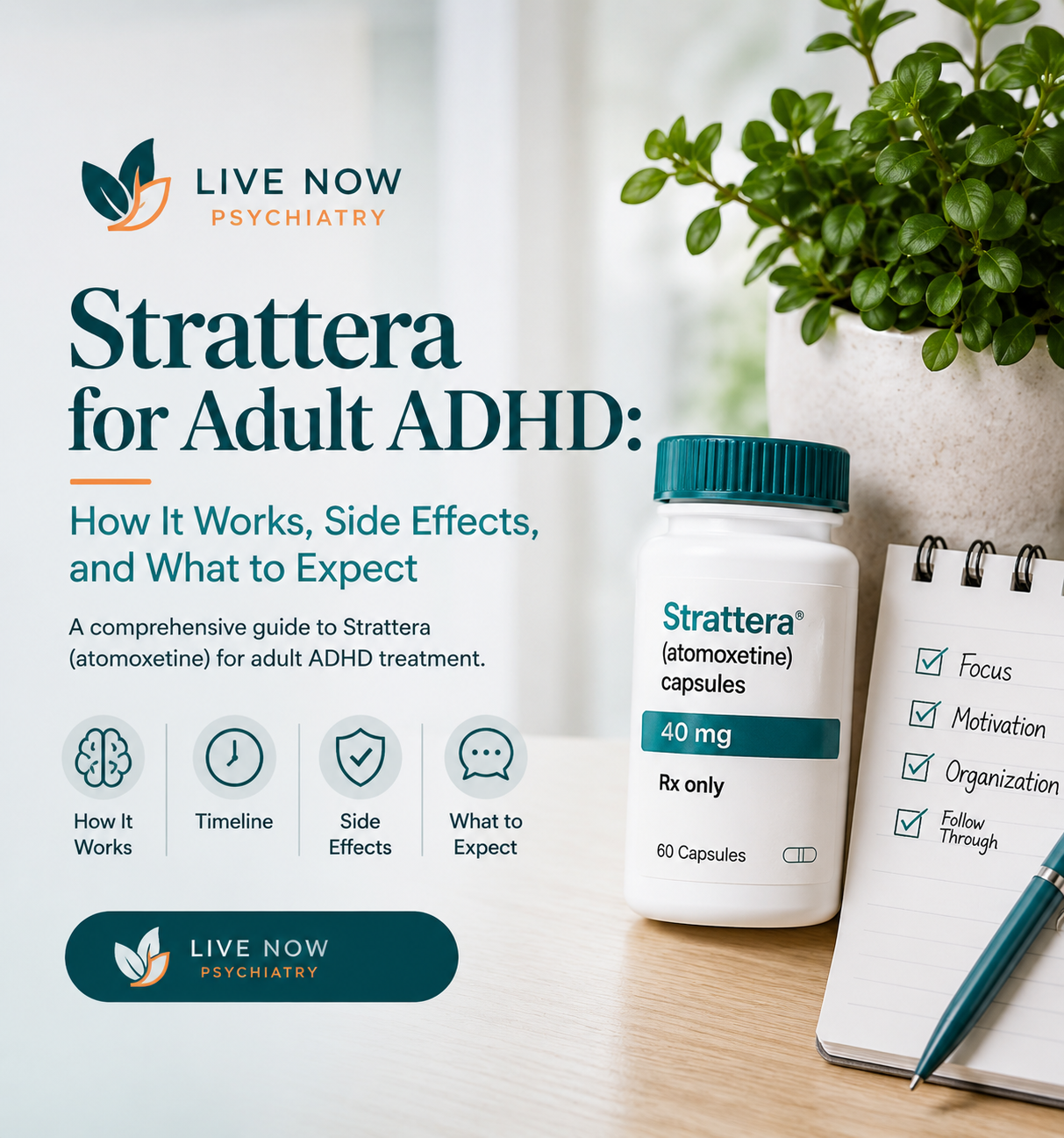
2. Atomoxetine, Also Known as Strattera

Atomoxetine, commonly known by the brand name Strattera, is a nonstimulant ADHD medication.

How Atomoxetine Works for ADHD

Atomoxetine is a norepinephrine reuptake inhibitor. It increases norepinephrine activity in the brain, which may help with attention, impulse control, emotional regulation, and executive functioning.

Unlike stimulant medications, atomoxetine usually does not work immediately. It may take several weeks to notice improvement, and full benefit may take longer.

Who May Benefit From Atomoxetine?

Atomoxetine may be considered for adults who:

  • Prefer a nonstimulant ADHD medication

  • Do not tolerate stimulant medications

  • Have anxiety that worsens with stimulants

  • Have concerns about controlled substances

  • Have a history of substance misuse

  • Need smoother all-day ADHD symptom coverage

  • Want an ADHD medication option that is not an amphetamine

Potential Benefits of Atomoxetine

Atomoxetine may help with:

  • Attention

  • Distractibility

  • Impulsivity

  • Emotional regulation

  • Task completion

  • Daytime ADHD symptoms

Possible Risks and Side Effects of Atomoxetine

Possible side effects may include:

  • Nausea

  • Decreased appetite

  • Fatigue

  • Dry mouth

  • Dizziness

  • Sleep changes

  • Sexual side effects

  • Mood changes

Serious risks may include allergic reactions, liver problems, changes in mood, suicidal thoughts in some individuals, blood pressure or heart rate changes, urinary problems, medication interactions, or other significant adverse reactions. Patients should report concerning symptoms promptly to a healthcare provider.

3. Viloxazine, Also Known as Qelbree

Viloxazine, known by the brand name Qelbree, is another nonstimulant ADHD medication.

How Viloxazine Works for ADHD

Viloxazine affects norepinephrine and may also influence other neurotransmitter systems involved in attention, mood, and executive functioning.

Viloxazine is not an amphetamine and is not classified as a stimulant medication.

Potential Benefits of Viloxazine

Viloxazine may help with:

  • Inattention

  • Impulsivity

  • Emotional regulation

  • Task completion

  • Daytime ADHD symptoms

Possible Risks and Side Effects of Viloxazine

Possible side effects may include:

  • Sleepiness

  • Fatigue

  • Decreased appetite

  • Nausea

  • Irritability

  • Insomnia

  • Headache

  • Mood changes

Serious risks may include worsening mood, suicidal thoughts in some individuals, allergic reactions, blood pressure or heart rate changes, medication interactions, or other serious side effects. Patients should be carefully screened and monitored.

4. Guanfacine, Also Known as Intuniv

Guanfacine is a nonstimulant ADHD medication that works differently from stimulants and norepinephrine reuptake inhibitors.

How Guanfacine Works for ADHD

Guanfacine is an alpha-2A adrenergic receptor agonist. It affects areas of the brain involved in impulse control, emotional regulation, attention, and executive functioning.

Guanfacine may be especially helpful when ADHD symptoms include impulsivity, emotional reactivity, hyperactivity, restlessness, or difficulty calming the mind.

Potential Benefits of Guanfacine

Guanfacine may help with:

  • Impulsivity

  • Hyperactivity

  • Emotional reactivity

  • Irritability

  • Restlessness

  • Sleep difficulties in some patients

Possible Risks and Side Effects of Guanfacine

Possible side effects may include:

  • Sleepiness

  • Fatigue

  • Dizziness

  • Low blood pressure

  • Slow heart rate

  • Dry mouth

  • Constipation

Serious risks may include dangerously low blood pressure, fainting, significant slowing of heart rate, sedation, medication interactions, or rebound blood pressure elevation if stopped suddenly. Guanfacine should not be stopped abruptly unless directed by a healthcare professional.

5. Clonidine, Also Known as Kapvay

Clonidine is another nonstimulant ADHD medication. It may be used when ADHD symptoms include hyperactivity, impulsivity, physical restlessness, sleep difficulty, or emotional reactivity.

How Clonidine Works for ADHD

Clonidine affects nervous system signaling and may reduce overarousal, impulsivity, and restlessness in some patients.

Potential Benefits of Clonidine

Clonidine may help with:

  • Hyperactivity

  • Impulsivity

  • Restlessness

  • Sleep problems

  • Emotional reactivity

  • Physical overactivation

Possible Risks and Side Effects of Clonidine

Possible side effects may include:

  • Drowsiness

  • Fatigue

  • Dizziness

  • Low blood pressure

  • Slow heart rate

  • Dry mouth

  • Constipation

Serious risks may include fainting, dangerously low blood pressure, significant sedation, slow heart rate, medication interactions, or rebound hypertension if stopped suddenly. Clonidine should not be discontinued abruptly without medical guidance.

6. Bupropion, Also Known as Wellbutrin

Bupropion is an antidepressant that may sometimes be used off-label for ADHD.

“Off-label” means a medication is being used for a condition or symptom that is not its primary FDA-approved indication. Off-label prescribing can be clinically appropriate in some situations, but it requires individualized medical judgment.

How Bupropion Works

Bupropion affects dopamine and norepinephrine, which are neurotransmitters involved in attention, motivation, energy, and mood.

Who May Benefit From Bupropion?

Bupropion may be considered for some adults with ADHD symptoms who also experience:

  • Depression

  • Low motivation

  • Low energy

  • Difficulty concentrating

  • Nicotine dependence

  • Stimulant intolerance

Potential Benefits of Bupropion

Bupropion may help with:

  • Motivation

  • Focus

  • Energy

  • Mood

  • Concentration

  • Task initiation

Possible Risks and Side Effects of Bupropion

Possible side effects may include:

  • Insomnia

  • Anxiety or jitteriness

  • Dry mouth

  • Headache

  • Appetite changes

  • Increased blood pressure

  • Irritability

Serious risks may include seizures, allergic reactions, mood worsening, suicidal thoughts in some individuals, increased blood pressure, medication interactions, and other potentially serious adverse effects. Bupropion is generally avoided in patients with seizure disorders or certain eating disorders due to seizure risk.

Newer ADHD Medications

Newer ADHD medications include options such as Qelbree, a nonstimulant medication approved for ADHD in adults and children age 6 and older; Azstarys, a once-daily methylphenidate-based stimulant; Xelstrym, a dextroamphetamine patch; and Onyda XR, a once-daily clonidine extended-release oral suspension. Some of these medications are controlled substances and some are not. The best option depends on the patient’s symptoms, medical history, blood pressure, heart rate, sleep, prior medication response, side effects, and treatment goals.

7. Other Off-Label ADHD Medication Options

In some cases, other medications may be considered off-label when ADHD symptoms overlap with depression, anxiety, low energy, chronic pain, sleep problems, or executive dysfunction.

These may include certain antidepressants that affect norepinephrine or other neurotransmitter systems.

However, these medications are not first-line ADHD treatments for everyone and require careful clinical evaluation. Medication choice depends on symptoms, medical history, psychiatric history, other medications, side effect risks, and safety considerations.

Some antidepressants are sometimes used off-label for adult ADHD, especially bupropion/Wellbutrin. Less commonly, tricyclic antidepressants or certain norepinephrine-related antidepressants may be considered in select cases. These medications are not FDA-approved first-line ADHD treatments, and the best option depends on symptoms, depression/anxiety history, sleep, blood pressure, heart rate, cardiac history, seizure risk, substance-use history, and prior medication response.

8. Therapy and Behavioral Strategies for Adult ADHD

Medication can help, but medication is not the entire treatment plan for every person.

Many adults with ADHD benefit from therapy, coaching, structure, and behavioral strategies.

Helpful non-medication strategies may include:

  • Cognitive behavioral therapy for ADHD

  • Time-blocking

  • Calendar reminders

  • Breaking tasks into smaller steps

  • Reducing distractions

  • Sleep consistency

  • Exercise

  • External accountability

  • Written plans

  • Organized routines

  • Systems for bills, appointments, and responsibilities

ADHD treatment often works best when medication and practical strategies are combined.

How Do You Know Which ADHD Medication Is Right for You?

There is no single “best” ADHD medication for everyone.

The right ADHD medication depends on many factors, including:

  • ADHD symptoms

  • Age

  • Blood pressure

  • Heart rate

  • Sleep quality

  • Anxiety symptoms

  • Depression history

  • Bipolar disorder history

  • Psychosis history

  • Substance use history

  • Cardiac history

  • Family cardiac history

  • Current medications

  • Medication allergies

  • Prior medication response

  • Side effect sensitivity

  • Personal treatment goals

A psychiatric provider may consider whether the main challenges are inattention, impulsivity, motivation, task completion, emotional regulation, restlessness, or sleep disruption.

The goal is to choose the safest, most appropriate, and most sustainable ADHD treatment plan for the individual patient.

When Might a Nonstimulant ADHD Medication Be Considered?

A nonstimulant for adults with ADHD in Florida may be considered when:

  • Stimulants cause insomnia

  • Stimulants worsen anxiety

  • Stimulants suppress appetite too much

  • Blood pressure or heart rate is a concern

  • There is a history of substance misuse

  • The patient prefers to avoid controlled substances

  • There are intolerable stimulant side effects

  • There is concern about misuse, dependence, or diversion

  • ADHD symptoms need smoother all-day coverage

  • A patient wants an ADHD medication option besides Adderall or Vyvanse

Nonstimulants may take longer to work, but they can be valuable options for many patients.

Do Nonstimulants Work as Well as Stimulants?

Stimulants often work faster and may have a stronger immediate effect for many individuals with ADHD. However, nonstimulants can still be effective, especially when stimulants are not tolerated, not preferred, or not clinically appropriate.

For some patients, the best option may be a stimulant. For others, it may be atomoxetine, viloxazine, guanfacine, clonidine, bupropion, or another carefully selected treatment.

Medication decisions should always be individualized and made after a proper evaluation.

Online ADHD Treatment for Adults in Florida

Live Now Psychiatry provides online ADHD treatment for adults in Florida. Care may include ADHD evaluation, medication management, supportive therapy, and individualized treatment planning.

Online psychiatric care may be a helpful option for adults who want convenient, private ADHD treatment from home. Live Now Psychiatry serves adults 18 and older located in Florida through secure telehealth appointments.

ADHD treatment may be appropriate for adults who struggle with focus, procrastination, disorganization, impulsivity, restlessness, emotional overwhelm, or difficulty completing daily responsibilities.

At Live Now Psychiatry, medication decisions are thoughtful, careful, and individualized. If amphetamine-based medications are not the right fit, other ADHD medication options may be discussed when clinically appropriate.

Frequently Asked Questions About ADHD Medication Options for Adults in Florida

1) What are ADHD medication options besides Adderall and Vyvanse?

ADHD medication options besides Adderall and Vyvanse may include methylphenidate-based stimulants such as Ritalin, Concerta, and Focalin, as well as nonstimulant medications such as atomoxetine, viloxazine, guanfacine, and clonidine. In some cases, off-label options such as bupropion may be considered.

2) Can ADHD be treated without amphetamines?

Yes. ADHD can sometimes be treated without amphetamines. Options may include methylphenidate-based stimulants, nonstimulant ADHD medications, therapy, coaching, behavioral strategies, or certain off-label medications when clinically appropriate.

3) What is the best nonstimulant medication for ADHD?

There is no single best nonstimulant ADHD medication for everyone. Atomoxetine, viloxazine, guanfacine, and clonidine may each be considered depending on the patient’s symptoms, medical history, psychiatric history, cardiac history, side effect risk, and treatment goals.

4) Do nonstimulant ADHD medications work immediately?

Usually not. Unlike stimulant medications, nonstimulants often take time to build up and show benefit. Some people may notice improvement within a few weeks, while others may need longer to evaluate the full effect.

5) Are nonstimulants safer than stimulants?

Not necessarily for everyone. Nonstimulants may be safer or more appropriate for certain patients, but they can still cause side effects, serious adverse reactions, medication interactions, and potentially life-threatening complications in rare cases. “Nonstimulant” does not mean “risk-free.”

6) Can ADHD medication make anxiety worse?

Yes. Some ADHD medications can worsen anxiety in certain individuals. However, untreated ADHD can also contribute to anxiety by causing overwhelm, procrastination, missed deadlines, disorganization, and daily stress. A provider can help determine whether anxiety is separate from ADHD, worsened by ADHD, or affected by medication.

7) Can adults take ADHD medication?

Yes. Adults can be evaluated and treated for ADHD. Many adults were never diagnosed as children and only recognize their symptoms later in life.

8) Is Wellbutrin used for ADHD?

Wellbutrin, also known as bupropion, is not FDA-approved specifically for ADHD, but it may sometimes be used off-label when clinically appropriate. It may be considered when ADHD symptoms overlap with depression, low motivation, low energy, or concentration problems.

9) Is bupropion a stimulant?

No. Bupropion is not a stimulant. It is an antidepressant that affects dopamine and norepinephrine and may sometimes be used off-label for ADHD.

10) Do I need therapy if I take ADHD medication?

Not always, but therapy or ADHD-focused behavioral strategies can be very helpful. Medication may improve focus and impulse control, while therapy and structure can help with routines, organization, planning, and follow-through.

11) Does Live Now Psychiatry provide ADHD treatment in Florida?

Yes. Live Now Psychiatry provides online psychiatric care for adults in Florida. ADHD care may include evaluation, medication management, supportive therapy, and individualized treatment planning when appropriate.

ADHD Treatment in Florida Through Live Now Psychiatry

Live Now Psychiatry provides online psychiatric care for adults in Florida. Treatment may include ADHD evaluation, medication management, supportive therapy, and individualized care planning.

ADHD care should be thoughtful, careful, and personalized. At Live Now Psychiatry, medication decisions are made based on a patient’s symptoms, medical history, psychiatric history, risk factors, treatment goals, and ongoing response.

If amphetamine-based stimulants are not the right fit, other ADHD medication options may be discussed when clinically appropriate.


If you are an adult in Florida struggling with focus, procrastination, disorganization, impulsivity, restlessness, emotional overwhelm, or difficulty completing tasks, you may benefit from an ADHD screening.

Live Now Psychiatry offers a free 15-minute screening to help determine whether our practice may be an appropriate fit for your needs.

Adults 18+
Florida only
Self-pay
HIPAA-compliant telehealth

Important Medical Disclaimer

This blog is for general educational and informational purposes only. It is not medical advice, psychiatric advice, diagnosis, treatment, or a substitute for individualized evaluation by a qualified healthcare professional. Reading this article does not create a provider-patient relationship with Live Now Psychiatry or Rebecca Sommer, MSN, APRN, PMHNP-BC, FNP-C.

Medication decisions should only be made after a complete individualized clinical evaluation. The medications discussed in this article may not be appropriate, safe, effective, or indicated for every person. Some uses may be off-label. Medication risks vary based on personal medical history, psychiatric history, cardiac history, family history, current medications, allergies, substance use history, pregnancy status, and other individual factors.

All medications, including ADHD medications, stimulants, nonstimulants, antidepressants, and off-label medications, can cause side effects. Some side effects may be mild, while others may be serious, severe, permanent, or potentially life-threatening. Possible serious risks may include, but are not limited to, allergic reactions, anaphylaxis, dangerously high or low blood pressure, abnormal heart rhythm, increased heart rate, cardiac events, stroke, seizures, liver injury, serotonin syndrome, severe mood changes, suicidal thoughts, worsening anxiety, agitation, psychosis, mania, dependence, misuse, medication interactions, and other serious adverse reactions.

Do not start, stop, increase, decrease, or combine medications without guidance from a qualified healthcare professional. Do not stop certain medications abruptly unless instructed by a healthcare professional, as this may cause withdrawal symptoms, rebound symptoms, blood pressure changes, or other serious complications.

If you experience chest pain, trouble breathing, fainting, severe allergic reaction, swelling of the face or throat, severe rash, confusion, seizure, severe mood changes, suicidal thoughts, thoughts of harming yourself or others, or any other emergency symptoms, call 911 or go to the nearest emergency room immediately.

Live Now Psychiatry does not provide emergency or crisis services and is not a 24-hour practice. If you are experiencing a medical or psychiatric emergency, call 911 or go to the nearest emergency room. If you are experiencing suicidal thoughts or a mental health crisis, call or text 988 for the Suicide & Crisis Lifeline.

Information on this website may change over time and should not be used as a substitute for professional medical evaluation, diagnosis, or treatment. Patients should speak directly with a qualified healthcare professional about their individual risks, benefits, and treatment options.

Read More

ADHD vs Anxiety: How to Tell the Difference in Adults

Wondering whether your symptoms are ADHD or anxiety? Learn the key differences between ADHD and anxiety in adults, common symptoms, how both conditions can overlap, and when to seek professional evaluation and treatment in Florida.

Difficulty focusing, forgetfulness, racing thoughts, procrastination, and feeling overwhelmed can occur in both Attention-Deficit/Hyperactivity Disorder (ADHD) and anxiety disorders.

Because these conditions often share similar symptoms, many adults wonder whether they are experiencing ADHD, anxiety, or both.

Understanding the differences between ADHD and anxiety can help you determine whether professional evaluation may be beneficial.

At Live Now Psychiatry, we provide online psychiatric care for adults across Florida with clear, upfront pricing and no insurance requirements.

Adults 18+ • Florida only • Secure telehealth • Self-pay pricing

Appointments are available this week for Florida residents.

No pressure. Quick 15-minute call to see if we’re the right fit.

What Is ADHD?

Attention-Deficit/Hyperactivity Disorder (ADHD) is a neurodevelopmental condition that affects attention, organization, impulse control, task completion, and executive functioning.

While ADHD often begins during childhood, many individuals continue experiencing symptoms into adulthood.

Common symptoms of adult ADHD may include:

  • Difficulty sustaining attention

  • Forgetfulness

  • Chronic procrastination

  • Losing important items

  • Disorganization

  • Poor time management

  • Frequently interrupting others

  • Difficulty completing tasks

  • Restlessness

  • Trouble following through on plans

What is anxiety?

Anxiety involves excessive worry, fear, nervousness, or anticipation of potential problems.

Everyone experiences anxiety occasionally. However, anxiety disorders involve symptoms that become persistent, excessive, or interfere with daily functioning.

Common symptoms of anxiety may include:

  • Excessive worrying

  • Racing thoughts

  • Feeling on edge

  • Difficulty relaxing

  • Muscle tension

  • Irritability

  • Difficulty sleeping

  • Trouble concentrating

  • Feeling overwhelmed

  • Physical symptoms such as increased heart rate or stomach discomfort

Why ADHD and Anxiety Are Often Confused?

Both ADHD and anxiety can affect concentration, productivity, and daily functioning.

For example, individuals with either condition may:

  • Have difficulty focusing

  • Feel overwhelmed

  • Procrastinate

  • Forget important tasks

  • Struggle at work or school

  • Have trouble completing projects

Because symptoms overlap, determining the underlying cause can sometimes be challenging without a comprehensive evaluation.

Signs Your Symptoms May Be More Related to ADHD

Your symptoms may be more consistent with ADHD if you:

  • Have struggled with focus since childhood

  • Frequently lose items

  • Are chronically disorganized

  • Have difficulty managing time

  • Start tasks but struggle to finish them

  • Frequently interrupt conversations

  • Become distracted easily

  • Have a history of academic or workplace difficulties related to attention

Many adults with ADHD describe knowing exactly what needs to be done but having difficulty getting started or staying focused long enough to complete tasks.

Signs Your Symptoms May Be More Related to Anxiety

Your symptoms may be more consistent with anxiety if you:

  • Frequently worry about future events

  • Experience excessive "what if" thinking

  • Feel tense or on edge most days

  • Notice symptoms worsen during stressful periods

  • Avoid situations because of fear or worry

  • Experience panic attacks

  • Have difficulty sleeping because your mind will not slow down

Many adults with anxiety report that their concentration difficulties occur because their attention is consumed by worry.

Can You Have Both ADHD and Anxiety?

Yes.

ADHD and anxiety commonly occur together.

For example:

An adult with ADHD may become anxious because they frequently miss deadlines, forget appointments, or struggle with organization.

Likewise, chronic anxiety may make concentration more difficult and worsen existing ADHD symptoms.

Because these conditions often overlap, a comprehensive psychiatric evaluation is important.

Questions a Psychiatric Provider May Ask

During an evaluation, you may be asked about:

  • Childhood symptoms

  • School performance

  • Work performance

  • Organization skills

  • Concentration difficulties

  • Sleep

  • Anxiety symptoms

  • Mood symptoms

  • Medical history

  • Family history

The goal is to understand the full picture rather than focusing on a single symptom.

When Should You Seek Professional Help?

Consider seeking an evaluation if:

  • Symptoms are interfering with work

  • Relationships are suffering

  • Daily responsibilities feel overwhelming

  • Concentration difficulties are worsening

  • Anxiety feels difficult to control

  • You frequently feel frustrated by your inability to focus

Seeking help early may improve quality of life and daily functioning.

Treatment Options

Treatment recommendations depend on the individual's symptoms, history, goals, and overall clinical picture.

Treatment may include:

Medication Management

For some individuals, medication may help improve symptoms of ADHD, anxiety, or both.

Medication decisions are individualized and based on each person's specific needs.

Supportive Therapy

Therapy may help individuals:

  • Develop coping skills

  • Improve organization

  • Manage anxiety

  • Reduce stress

  • Improve emotional regulation

Lifestyle Strategies

Lifestyle modifications may also play an important role, including:

  • Regular exercise

  • Consistent sleep habits

  • Time-management strategies

  • Stress reduction techniques

ADHD and Anxiety Evaluation in Florida

If you are struggling with concentration difficulties, excessive worry, procrastination, disorganization, or feeling overwhelmed, professional evaluation may help provide clarity.

Live Now Psychiatry provides online psychiatric care for adults throughout Florida.

Services may include:

  • Psychiatric evaluations

  • Medication management

  • Supportive therapy

  • Ongoing follow-up care

A free 15-minute screening call can help determine whether Live Now Psychiatry may be a good fit for your needs.

Adults throughout Florida can schedule a confidential screening to learn more about available services.


Frequently Asked Questions About Psychiatric Nurse Practitioners

1) Can anxiety look like ADHD?

Yes. Anxiety can cause concentration difficulties, forgetfulness, and feeling overwhelmed, which may sometimes resemble ADHD symptoms.

2) Why do anxiety and ADHD both cause trouble focusing?

Individuals with ADHD may struggle to focus because their attention shifts easily. Individuals with anxiety may struggle to focus because their minds are occupied by worry, fear, or racing thoughts.

3) Can adults develop ADHD later in life?

ADHD symptoms generally begin during childhood. However, many adults are not diagnosed until later in life when symptoms become more noticeable or responsibilities increase.

4) Can ADHD be mistaken for anxiety?

Yes. Because both conditions can cause concentration difficulties, restlessness, irritability, and feeling overwhelmed, ADHD is sometimes mistaken for anxiety and vice versa.

5) How do I know if I have ADHD or anxiety?

A comprehensive psychiatric evaluation can help determine whether symptoms are related to ADHD, anxiety, or both.

6) Can ADHD cause anxiety?

Yes. Many adults with ADHD experience anxiety related to deadlines, organization difficulties, procrastination, and daily responsibilities.

7) Is it possible to have both ADHD and anxiety?

Yes. ADHD and anxiety commonly occur together and may influence one another.

8) Can ADHD and anxiety be treated through telehealth?

Many adults receive evaluation and treatment for ADHD and anxiety through secure telehealth appointments.


Ready to Start Online Psychiatric Care in Florida?

If you're looking for a psychiatric provider who offers medication management and supportive care, a PMHNP may be the right fit.

At Live Now Psychiatry, we provide online psychiatric care for adults across Florida with transparent, self-pay pricing and fast access to appointments.

Book your free 15-minute screening today to get started.

Read More

Online Depression Treatment in Florida for Adults

Depression can impact your mood, energy, and motivation. Learn how online depression treatment in Florida can help you feel better.

Looking for depression treatment in Florida?

Depression can affect mood, energy, motivation, and daily functioning. Many adults also experience overlapping concerns such as anxiety, ADHD symptoms, trauma-related stress, or burnout.

At Live Now Psychiatry, we provide online depression treatment for adults across Florida through secure telehealth. Care is personalized and may include medication management, supportive therapy, and ongoing monitoring based on your needs.

Adults 18+ • Florida only • Secure telehealth • Self-pay pricing

Online Depression Treatment in Florida: What You Should Know

Depression is a common but serious condition that can affect how you feel, think, and function in your daily life.

Common symptoms of depression in adults may include:

• Persistent sadness or low mood

• Loss of interest or motivation

• Fatigue or low energy

Changes in sleep or appetite

• Difficulty concentrating

• Feelings of hopelessness or overwhelm

Depression can vary in severity and may develop gradually or suddenly.

At Live Now Psychiatry, treatment is individualized and may include:

• Medication management when appropriate

• Supportive therapy

• Monitoring of symptoms over time

• Adjustments to your treatment plan as needed

All services are provided through secure telehealth, allowing you to receive care in a private and convenient setting.

With the right treatment, many individuals experience meaningful improvement in symptoms and overall functioning.

What Is Depression?

Depression is a common mental health condition that can affect mood, energy levels, and overall functioning.

Symptoms may include low mood, fatigue, loss of interest in activities, difficulty concentrating, and changes in sleep or appetite.

With proper treatment, symptoms can improve significantly over time.

When Should You Seek Treatment?

• Persistent low mood
• Fatigue or low energy
• Loss of interest
• Difficulty functioning

How Online Depression Treatment Works

Getting started is simple:

  1. Schedule a free 15-minute screening

  2. Complete secure intake forms

  3. Attend your virtual evaluation

  4. Receive a personalized treatment plan

What to Expect During Your First Appointment

Your first visit includes a comprehensive psychiatric evaluation and personalized treatment plan.

Can a Nurse Practitioner Prescribe Depression Medication in Florida?

Yes. Psychiatric nurse practitioners in Florida can evaluate, diagnose, and treat depression, including prescribing medications when appropriate.

Benefits of Online DepressionTreatment

• Convenience
• Privacy
• Flexible scheduling
• Faster access

Self-Pay Online Psychiatry in Florida

Live Now Psychiatry offers transparent pricing with no insurance required.

You can also explore care for related concerns such as anxiety, ADHD, trauma, insomnia, and burnout.

Frequently Asked Questions About DepressionTreatment

1. What are common symptoms of depression in adults?
Depression may include persistent sadness, low energy, loss of interest, sleep changes, and difficulty concentrating.

2. When should I seek help for depression?
If symptoms last more than two weeks or begin affecting your daily life, relationships, or work, it may be time to seek support.

3. Is depression treatable?
Yes. Many adults improve with a combination of therapy, lifestyle changes, and medication when appropriate.

4. Can I get online depression treatment in Florida for adults?
Yes. Telepsychiatry allows adults in Florida to receive private, convenient care from home.

5. Do I need medication for depression?
Not always. Treatment is personalized and may or may not include medication depending on your needs.

6. How quickly can I get an appointment in Florida?
Most patients can schedule within a few days.

7. What is the first step to getting started?
Booking a free 15-minute screening is the easiest way to begin.

8. What happens after I book the screening?
You’ll complete secure intake forms and, if appropriate, schedule a full psychiatric evaluation.

9. How much does online depression treatment cost in Florida?
Live Now Psychiatry offers transparent self-pay pricing with no insurance required. You can start with a free 15-minute screening.

Ready to Start Depression Treatment in Florida?

If depression is affecting your daily life, support is available. You don’t have to go through it alone.

Live Now Psychiatry provides personalized online care for adults across Florida through secure telehealth. Treatment is tailored to your needs and may include medication management, supportive therapy, and ongoing follow-up.

Adults 18+ • Florida only • Secure telehealth • Self-pay pricing

Read More

Anxiety Treatment in Florida for Adults (Online Care)

Anxiety can affect your daily life, sleep, and relationships. Learn about symptoms and effective online anxiety treatment options available in Florida.

Looking for anxiety treatment in Florida? Many adults experience persistent worry, racing thoughts, and physical tension that can interfere with daily life.

At Live Now Psychiatry, we provide online anxiety treatment for adults in Florida, along with support for related concerns such as ADHD, depression, and trauma-related symptoms. Care is personalized and delivered through secure telehealth

Adults 18+ • Florida only • Secure telehealth • Self-pay pricing

Common Symptoms of Anxiety in Adults

If you are experiencing anxiety, understanding your symptoms and treatment options is an important first step.

Common symptoms of anxietyin adults may include:

• Persistent worry or overthinking

• Feeling restless or on edge

• Difficulty sleeping

• Muscle tension or chest tightness

• Difficulty concentrating

Anxiety can range from mild to severe and may interfere with work, relationships, and daily functioning.

Treatment for anxiety is personalized and based on your specific symptoms and history. At Live Now Psychiatry, anxiety treatment may include:

• Medication management when appropriate

• Supportive therapy and coping strategies

• Identifying triggers and patterns

• Ongoing monitoring and adjustments to your treatment plan

All care is provided through secure telehealth, making it easy to access support from home.

Early treatment can significantly improve quality of life and help prevent symptoms from worsening.

When Should You Seek Treatment?

• Constant worry
• Trouble relaxing
• Sleep issues
• Symptoms affecting daily life

How Anxiety Treatment Works

Getting started is simple:

  1. Schedule a free 15-minute screening

  2. Complete secure intake forms

  3. Attend your virtual evaluation

  4. Receive a personalized treatment plan

Can a Nurse Practitioner Prescribe Anxiety Medication in Florida?

Yes. Psychiatric nurse practitioners in Florida can evaluate, diagnose, and treat anxiety, including prescribing medications when appropriate.

What to Expect During Your First Appointment

Your first visit includes a comprehensive psychiatric evaluation and personalized treatment plan.

Related Conditions We Also Treat

Self-Pay Online Psychiatry in Florida

Transparent pricing with no insurance required.

Frequently Asked Questions About Anxiety Treatment

1. What does anxiety feel like in adults?
Anxiety can include constant worry, racing thoughts, restlessness, and physical symptoms like tension or a fast heart rate.

2. When should I seek help for anxiety?
If anxiety is persistent or interfering with your daily life, sleep, or relationships, support can help.

3. Is anxiety treatable?
Yes. Many adults experience significant relief with therapy, coping strategies, and sometimes medication.

4. Can I get online anxiety treatment in Florida for adults?
Yes. Telehealth makes it easy to access care from the comfort of your home.

5. Do I need medication for anxiety?
Not necessarily. Treatment plans are individualized and may include therapy, medication, or both.

6. How fast can I get an appointment in Florida?
Appointments are often available within a few days.

7. What is the first step to getting help?
Start by booking a free 15-minute screening.

8. Is online anxiety treatment confidential?
Yes. All care is HIPAA-compliant and designed to protect your privacy.

9. How much does anxiety treatment cost in Florida?
Live Now Psychiatry offers transparent self-pay pricing with no insurance required. A free 15-minute screening is available to get started.

Ready to Start Anxiety Treatment in Florida?

If anxiety is affecting your daily life, support is available. You don’t have to manage it alone.

At Live Now Psychiatry, we provide personalized, compassionate care through secure online appointments for adults across Florida.

Adults 18+ • Florida only • Secure telehealth • Self-pay pricing


Read More

Online Psychiatric Care in Florida for Adults

Learn what to expect from online psychiatric care in Florida, including evaluation, diagnosis, and treatment from the comfort of your home.

Looking for online psychiatric care in Florida? Live Now Psychiatry provides telehealth mental health treatment for adults experiencing anxiety, ADHD, depression, insomnia, and stress.

Our practice offers convenient, private, and compassionate psychiatric care across Florida. Whether you are struggling with focus, mood, or emotional overwhelm, support is available.

We provide psychiatric evaluations, medication management when appropriate, and supportive therapy—all through secure telehealth visits.

Adults 18+ • Florida only • Secure telehealth • Self-pay pricing

Conditions Treated with Online Psychiatric Care in Florida

We treat a wide range of adult mental health conditions, including:

• ADHD (difficulty focusing, disorganization, low motivation)

‍ ‍

• Anxiety (overthinking, panic, constant worry)

• Depression (low mood, fatigue, lack of interest)

• Insomnia and sleep problems

• Stress, burnout, and life transitions

Each treatment plan is personalized to your needs.

Online Psychiatric Care in Florida: What to Expect

Starting psychiatric care can feel overwhelming, but the process is designed to be straightforward and supportive.

At Live Now Psychiatry, all appointments are conducted through secure, HIPAA-compliant telehealth.

During your initial evaluation, we will:

• Review your symptoms and concerns

• Discuss your medical and mental health history

• Identify any contributing factors

• Develop a personalized treatment plan

Treatment may include medication management, supportive therapy, and ongoing follow-up care.

Follow-up appointments focus on monitoring your progress, making adjustments as needed, and ensuring you feel supported throughout your care.

Telehealth allows you to receive high-quality psychiatric care from the comfort and privacy of your home.

Medication Management in Florida

Psychiatric nurse practitioners can prescribe medication when appropriate.

What to Expect During Your First Appointment

Your first visit includes a comprehensive psychiatric evaluation and personalized treatment plan.

Benefits of Online Psychiatric Care

  • Convenient care from home

  • Flexible scheduling

  • Private, secure telehealth visits

  • Personalized treatment plans

  • Ongoing support and follow-up care

Your first visit includes a comprehensive psychiatric evaluation and personalized treatment plan.

Frequently Asked Questions About Online Psychiatric Care in Florida

1. What is online psychiatric care in Florida?

It is mental health care provided through secure video visits for adults throughout Florida.

2. What happens during the first psychiatric evaluation?

You’ll discuss your symptoms, history, and goals to create a personalized treatment plan.

3. Is online psychiatric care effective?

Yes. Many adults benefit from telepsychiatry, which is both convenient and effective.

4. Can I receive care anywhere in Florida?

Yes. Services are available to adults across Florida.

5. Is telepsychiatry private and secure?

Yes. Visits are conducted through HIPAA-compliant platforms to protect your privacy.

6. How quickly can I get started?

Most patients can be seen within a few days.

7. What is the first step?

Book a free 15-minute screening to determine if care is a good fit.

8. What happens after the screening?

If appropriate, you’ll complete intake paperwork and schedule a full evaluation.

9. How much does online psychiatric care cost in Florida?

Live Now Psychiatry offers transparent self-pay pricing with no insurance required. You can start with a free screening.

Ready to Start Care?

Schedule a free 15-minute screening call to see if care is right for you.

Read More
ADHD Treatment, Medication Management Rebecca Sommer ADHD Treatment, Medication Management Rebecca Sommer

ADHD Treatment Florida for Adults

Struggling with focus, organization, or attention? Learn how online ADHD treatment in Florida works, including evaluation and medication management for adults.

If you’re searching for a psychiatric provider in Florida, you may be wondering: can a psychiatric nurse practitioner (PMHNP) prescribe medication?

The answer is yes. In Florida, PMHNPs are licensed to diagnose mental health conditions and prescribe medications when appropriate.

We serve adults across Florida, including Miami, Fort Lauderdale, Boca Raton, Delray Beach, Tampa, Orlando, and surrounding areas.

This guide explains how it works, what PMHNPs can prescribe, and how to get started with online psychiatric care in Florida.

At Live Now Psychiatry, we provide online psychiatric care for adults across Florida, including evaluation and treatment for ADHD, anxiety, depression, and related concerns. ADHD is a common neurodevelopmental condition that affects attention, organization, and executive functioning.

Appointments are conducted through secure telehealth, making it easy to get help from the comfort of your home.

Adult ADHD treatment in Florida does not have to be complicated or overwhelming.

Adults 18+ • Florida only • Secure telehealth • Self-pay pricing

Get evaluated and treated for ADHD from the comfort of your home. Appointments available this week for Florida residents.

No pressure. Just a quick 15-minute call to see if we’re the right fit.

ADHD Diagnosis for Adults in Florida

ADHD in adults is diagnosed through a comprehensive psychiatric evaluation. This includes reviewing your symptoms, history, and how ADHD affects your daily life.

There is no single test for ADHD. Instead, diagnosis is based on clinical criteria and a thorough assessment by a qualified provider.

If you're searching for ADHD diagnosis for adults in Florida, telehealth makes it easier to get evaluated quickly and privately.

Online ADHD Treatment in Florida: What to Expect

If you are considering ADHD treatment in Florida, understanding what to expect can help you feel more comfortable getting started.

At Live Now Psychiatry, online ADHD treatment in Florida is provided through secure, HIPAA-compliant telehealth, allowing you to receive care from the comfort of your home.

The process typically begins with a comprehensive psychiatric evaluation. During this visit, we will:

• Review your symptoms and how they impact your daily life

• Discuss your medical, psychiatric, and medication history

• Evaluate for co-occurring conditions such as anxiety or depression

• Determine whether ADHD diagnosis for adults is the most appropriate diagnosis

If ADHD is diagnosed, we will work together to create a personalized treatment plan. Treatment may include medication management, supportive therapy, and practical strategies to improve focus, organization, and productivity.

Follow-up appointments are used to monitor your progress, adjust medications if needed, and provide ongoing support.

All care is individualized, collaborative, and designed to help you function more effectively in your daily life.

What Is ADHD Treatment for Adults?

ADHD is a common condition that affects attention, organization, and executive functioning. In adults, symptoms often include difficulty concentrating, forgetfulness, disorganization, and feeling overwhelmed by daily tasks.

These challenges can impact productivity, relationships, and overall quality of life, but effective treatment can significantly improve symptoms.

How Online ADHD Treatment for Adults Works

Getting started is simple:

  1. Schedule a free 15-minute screening

  2. Complete secure intake forms

  3. Attend your virtual evaluation

  4. Receive a personalized treatment plan

Treatment may include medication, supportive therapy, and practical strategies to improve daily functioning.

Can a Nurse Practitioner Prescribe ADHD Medication in Florida?

Yes. Psychiatric nurse practitioners in Florida are licensed to evaluate, diagnose, and treat ADHD, including prescribing medications when appropriate.

Treatment decisions are based on a comprehensive psychiatric evaluation and your individual needs.

Benefits of Online ADHD Treatment For Adults

Many adults choose online care because it offers:

• Convenience from home


• Flexible scheduling


• Privacy and comfort


• Faster access to care

What Medications Are Used to Treat ADHD?

Treatment for ADHD may include stimulant and non-stimulant medications, depending on your symptoms, medical history, and individual needs.

Common options include medications that improve focus, attention, and impulse control. Your provider will review risks, benefits, and alternatives before starting any medication.

All treatment decisions are personalized and based on a comprehensive evaluation.

When Should You Seek Treatment?

You may benefit from ADHD treatment in Florida if:

• You struggle with focus or organization
• Tasks feel overwhelming or difficult to complete
• You frequently forget important details
• Symptoms interfere with work or daily life

Self-Pay Online Psychiatry in Florida

Live Now Psychiatry provides online psychiatric care for adults across Florida with transparent self-pay pricing and no insurance requirements.

Ready to Get Help for ADHD?

If you are experiencing symptoms of ADHD that are affecting your focus, productivity, or daily life, professional treatment can help.

At Live Now Psychiatry, we provide online ADHD treatment for adults in Florida.

Schedule your free 15-minute screening today to get started.

Appointments available this week for Florida residents.

No pressure. Just a quick 15-minute call to see if we’re the right fit.

Frequently Asked Questions About ADHD Treatment for Adults

1. What are symptoms of ADHD in adults?
Symptoms may include difficulty focusing, disorganization, forgetfulness, and trouble completing tasks.

2. How is ADHD diagnosed in adults in Florida?
Diagnosis involves a comprehensive evaluation of symptoms, history, and daily functioning.

3. Can ADHD be treated?
Yes. Many adults benefit from behavioral strategies and, when appropriate, medication.

4. Can I get online ADHD treatment in Florida for adults?
Yes. Telepsychiatry allows for convenient evaluation and treatment from home.

5. Do I need medication for ADHD?
Not always. Some patients benefit from non-medication strategies, while others may benefit from medication.

6. How quickly can I get an ADHD appointment in Florida?
Appointments are often available within a few days.

7. What is the first step to getting started?
Book a free 15-minute screening.

8. What happens after I book the screening?
You’ll complete intake forms and schedule a full evaluation if appropriate.

9. How much does ADHD treatment cost in Florida?
Live Now Psychiatry offers transparent self-pay pricing. You can start with a free 15-minute screening.

Read More

Can a PMHNP Prescribe Medication in Florida? What Patients Should Know

Can a psychiatric nurse practitioner prescribe medication in Florida? Learn what PMHNPs can treat and how online care works.

If you’re searching for a psychiatric provider in Florida, you may be wondering: can a psychiatric nurse practitioner (PMHNP) prescribe medication?

The answer is yes. In Florida, PMHNPs are licensed to diagnose mental health conditions and prescribe medications when appropriate.

This guide explains how it works, what PMHNPs can prescribe, and how to get started with online psychiatric care in Florida.

Wondering how much psychiatric care costs in Florida? Many adults are choosing self-pay psychiatry for faster access and transparent pricing.

At Live Now Psychiatry, we provide online psychiatric care for adults across Florida with clear, upfront pricing and no insurance requirements.

Adults 18+ • Florida only • Secure telehealth • Self-pay pricing

Appointments are available this week for Florida residents.

No pressure. Quick 15-minute call to see if we’re the right fit.

Can a PMHNP Prescribe Medication in Florida

Yes. In Florida, psychiatric nurse practitioners (PMHNPs) are licensed to evaluate, diagnose, and treat mental health conditions, including prescribing medications when appropriate. PMHNPs provide comprehensive psychiatric care and are an alternative to traditional in-person psychiatry, especially through telehealth.

PMHNPs are advanced practice registered nurses with specialized training in psychiatric care. They are qualified to provide comprehensive mental health services, including:

• Diagnostic evaluations

• Medication management

• Supportive therapy

• Ongoing follow-up care

Medications may be prescribed for conditions such as:

•Anxiety treatment in Florida

•Depression treatment in Florida‍ ‍

•ADHD treatment for adults in Florida‍ ‍

• Insomnia treatment in Florida

Prescribing decisions are based on a thorough clinical evaluation, medical history, and individual patient needs.

At Live Now Psychiatry, all treatment decisions are collaborative, and we review risks, benefits, and alternatives before starting any medication. If you’re seeking help, explore adult ADHD treatment in Florida.

We serve patients across Florida, including Miami, Fort Lauderdale, Boca Raton, Delray Beach, Tampa, and Orlando.

What Can a PMHNP Prescribe in Florida?

PMHNPs in Florida can prescribe a wide range of psychiatric medications, including:

• Antidepressants for depression and anxiety

• Anti-anxiety medications

• ADHD medications (including stimulants when appropriate)

• Mood stabilizers

• Sleep medications

All prescriptions are based on a comprehensive psychiatric evaluation and individualized treatment plan.

What Is Self-Pay Psychiatry?

Self-pay psychiatry means you pay directly for services without using insurance.

How Much Does Online Psychiatry Cost in Florida?

The cost of online psychiatry in Florida varies depending on the provider and services offered. Self-pay practices like Live Now Psychiatry provide transparent pricing, flexible scheduling, and faster access to care without insurance restrictions

Benefits of Self-Pay Psychiatry

• No insurance restrictions
• Faster appointments
• More privacy
• Clear pricing

How It Works

Getting started is simple:

  1. Schedule a free 15-minute screening

  2. Complete secure intake forms

  3. Attend your virtual evaluation

  4. Receive a personalized treatment plan

Looking for a Psychiatric Provider in Florida?

Live Now Psychiatry offers evaluation and medication management through secure telehealth. Learn more about our online psychiatric care for adults in Florida.

Frequently Asked Questions About Psychiatric Nurse Practitioners

1. Can a PMHNP prescribe medication in Florida?
Yes. Licensed psychiatric nurse practitioners can prescribe medications, including controlled substances when appropriate.

2. Are PMHNPs qualified to treat mental health conditions?
Yes. PMHNPs are trained to assess, diagnose, and treat a wide range of mental health conditions.

3. Is care from a PMHNP different from a psychiatrist?
Both are qualified providers who can diagnose and treat mental health conditions.

4. What types of medications can be prescribed?
This may include medications for anxiety, depression, ADHD, and other conditions when clinically appropriate.

5. Is online prescribing safe and legal in Florida?
Yes. Care is provided through secure, HIPAA-compliant telehealth platforms following all regulations.

6. How quickly can I get an appointment?
Most patients can schedule within a few days.

7. What is the first step to getting care?
Book a free 15-minute screening.

8. What happens after the screening?
If appropriate, you’ll complete intake forms and schedule a full evaluation.

9. How much does psychiatric care cost in Florida?
Live Now Psychiatry offers transparent self-pay pricing with no insurance required.

Ready to Start Online Psychiatric Care in Florida?

If you're looking for a psychiatric provider who offers medication management and supportive care, a PMHNP may be the right fit.

At Live Now Psychiatry, we provide online psychiatric care for adults across Florida with transparent, self-pay pricing and fast access to appointments.

Book your free 15-minute screening today to get started.

Read More