
High-Functioning Anxiety: Signs You May Be Struggling Even When You Seem Fine
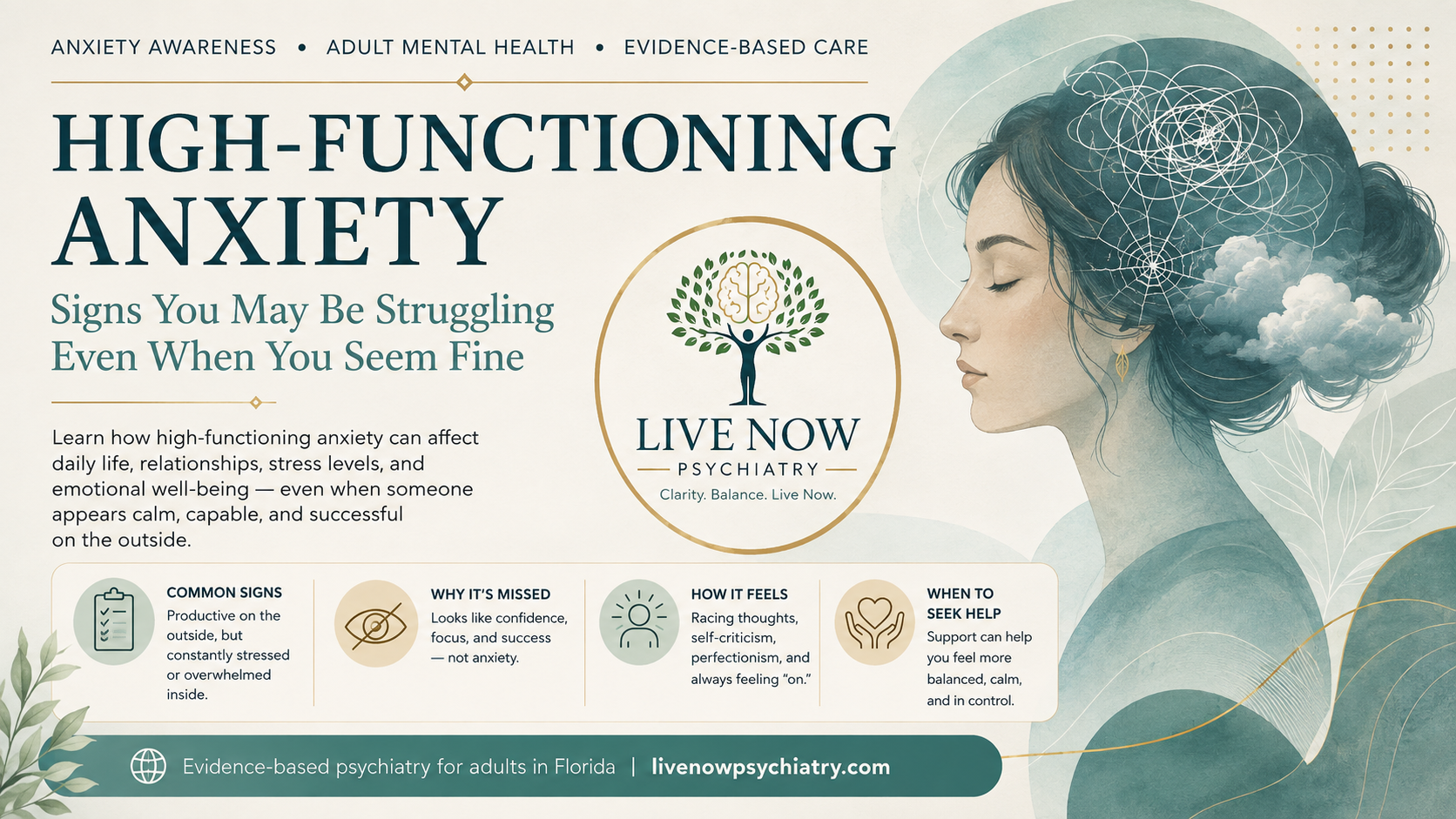
Some adults with anxiety appear completely fine from the outside.
They may be productive, responsible, organized, successful at work, socially engaged, and dependable. They may show up on time, meet deadlines, help other people, and seem calm under pressure.
But internally, they may feel constantly tense, worried, mentally exhausted, unable to relax, or afraid of making mistakes.
The phrase “high-functioning anxiety” is commonly used to describe this experience.
High-functioning anxiety is not a formal psychiatric diagnosis. It is an informal term often used to describe people who appear to function well externally while experiencing significant anxiety internally.
At Live Now Psychiatry, Florida adults can receive online anxiety evaluations and treatment through secure telehealth appointments.
This guide explains what high-functioning anxiety can look like, common signs, how it can affect work and relationships, why it may be overlooked, how it differs from normal stress, and when professional evaluation may be worth considering.
Adults 18+ • Florida only • Secure telehealth • Self-pay psychiatric care
What Is High-Functioning Anxiety?
“High-functioning anxiety” is not an official DSM diagnosis.
It is a descriptive term used when someone appears capable and successful while still experiencing persistent anxiety symptoms.
A person may:
Perform well at work
Maintain relationships
Meet deadlines
Stay highly organized
Appear confident
Take care of responsibilities
while internally experiencing:
Excessive worry
Fear of failure
Perfectionism
Difficulty relaxing
Overthinking
Muscle tension
Sleep problems
Irritability
Constant mental pressure
The fact that someone is functioning does not mean they are not struggling.
Can You Have Anxiety Even if You Are Successful?
Yes.
Anxiety is not limited to people who are visibly overwhelmed or unable to function.
Some adults respond to anxiety by becoming more:
Prepared
Perfectionistic
Organized
Hardworking
Responsible
Controlling
Achievement-focused
These behaviors may help them succeed.
But they may also be driven by fear.
For example:
“If I do not prepare for every possible outcome, something will go wrong.”
or:
“If I make one mistake, everyone will realize I am not good enough.”
From the outside, this may look like ambition.
Internally, it may feel exhausting.
Why High-Functioning Anxiety Can Be Hard to Recognize
People often assume anxiety must look obvious.
They may expect someone with anxiety to:
Avoid work
Miss responsibilities
Have visible panic attacks
Appear nervous
Withdraw socially
But some adults compensate very effectively.
They may hide anxiety by becoming highly productive.
This can delay recognition because:
Other people think they are doing well
The person compares themselves to people who appear more impaired
Success is used as evidence that nothing is wrong
Anxiety-driven habits are rewarded
The person may believe constant stress is normal
Signs of High-Functioning Anxiety in Adults
Not everyone experiences anxiety the same way.
However, the following patterns may be worth paying attention to when they are persistent and distressing.
1. Constant Overthinking
You may replay:
Conversations
Decisions
Emails
Mistakes
Future plans
You may repeatedly ask yourself:
Did I say the wrong thing?
Did I offend them?
What if I made a mistake?
What if something goes wrong?
What if I forgot something?
The mind may feel as though it never fully shuts off.
2. Perfectionism
Perfectionism can be a major feature of high-functioning anxiety.
You may feel that:
Mistakes are unacceptable
Work must be perfect
You need to exceed expectations
“Good enough” is not enough
Other people are constantly evaluating you
This can lead to excellent performance.
It can also lead to exhaustion.
3. Fear of Failure
Even when things are going well, you may feel as though one mistake could ruin everything.
This can lead to:
Overpreparing
Double-checking
Avoiding risks
Difficulty delegating
Working longer than necessary
Success does not always reduce the anxiety.
Sometimes the standard simply gets higher.
4. Difficulty Relaxing
Some adults with high-functioning anxiety feel uncomfortable doing nothing.
Rest may trigger thoughts such as:
I should be productive
I am wasting time
There is something I should be doing
I am falling behind
Even vacations or weekends may feel stressful.
5. Needing to Stay Busy
Constant activity can sometimes be a way of avoiding anxious thoughts.
You may keep your schedule full because slowing down makes worry more noticeable.
Examples include:
Working long hours
Constantly cleaning
Scheduling every free moment
Taking on too many responsibilities
Rarely resting
Busyness may temporarily distract from anxiety.
6. Chronic Worry
High-functioning anxiety may involve worry across many areas of life.
For example:
Work
Finances
Relationships
Health
Family
Future plans
Social interactions
Even when one problem is resolved, another worry may quickly replace it.
7. Trouble Sleeping
Anxiety can make it difficult to:
Fall asleep
Stay asleep
Stop thinking at night
Wake feeling rested
A person may be physically exhausted but mentally alert.
If anxiety is interfering with sleep, read Insomnia and Anxiety: Why They Often Happen Together and When to Seek Help(link to your insomnia/anxiety article).
8. Replaying Conversations
After social interactions, you may repeatedly review what happened.
You may think:
Did I talk too much?
Did I sound awkward?
Did they think I was rude?
Why did I say that?
This can happen even when the conversation went completely normally.
9. People-Pleasing
Some adults with anxiety become highly focused on keeping everyone else happy.
They may:
Avoid saying no
Agree to things they do not want to do
Take on extra responsibilities
Avoid conflict
Worry about disappointing others
This may reduce immediate anxiety but create resentment and burnout over time.
10. Difficulty Setting Boundaries
You may know you are overwhelmed but still feel unable to say:
No
I cannot do that
I need more time
I need help
Fear of disappointing others may override your own limits.
11. Excessive Preparation
Preparing is healthy.
But anxiety may turn preparation into:
Rehearsing conversations repeatedly
Arriving extremely early
Checking directions many times
Preparing for unlikely problems
Writing and rewriting simple emails
The goal may be to eliminate uncertainty.
But uncertainty can never be eliminated completely.
12. Constantly Checking Your Work
Some adults repeatedly check:
Emails
Documents
Locks
Calendars
Schedules
Messages
Checking can temporarily reduce anxiety.
But repeated reassurance-seeking may reinforce the worry.
13. Difficulty Making Decisions
Even small decisions may feel unusually stressful.
You may worry about:
Choosing the wrong restaurant
Buying the wrong item
Sending the wrong message
Making the wrong career decision
The problem is not always indecisiveness itself.
It may be fear of making an imperfect choice.
14. Physical Tension
Anxiety often affects the body.
Possible symptoms include:
Tight shoulders
Jaw clenching
Headaches
Muscle tension
Stomach discomfort
Rapid heart rate
Sweating
Trembling
Some adults do not realize how tense they are until they consciously try to relax.
15. Irritability
Chronic anxiety can reduce frustration tolerance.
You may feel:
Easily annoyed
Impatient
Overstimulated
Snappy
Mentally exhausted
This can affect relationships even when you appear calm in professional settings.
16. Feeling Mentally Exhausted
Constant worry consumes energy.
A person may function well all day and then feel completely depleted afterward.
You may describe:
Emotional exhaustion
Needing silence after work
Feeling unable to make another decision
Wanting to withdraw after being productive all day
17. Needing Reassurance
You may repeatedly ask others:
Does this look okay?
Are you mad at me?
Did I do something wrong?
Do you think this was the right decision?
Reassurance may help temporarily.
But the anxiety often returns.
18. Difficulty Delegating
Delegating requires accepting that someone else may do things differently.
For a perfectionistic or anxious person, that can feel uncomfortable.
You may think:
“It is easier if I just do it myself.”
This can lead to taking on too much.
19. Appearing Calm While Feeling Panicked Inside
One of the defining experiences of high-functioning anxiety may be the gap between external appearance and internal experience.
Other people may say:
“You are so calm.”
while internally you feel:
Tense
Worried
Overwhelmed
Afraid of making a mistake
High-Functioning Anxiety vs. Generalized Anxiety Disorder
High-functioning anxiety is not a formal diagnosis.
Generalized anxiety disorder, or GAD, is.
GAD involves excessive anxiety and worry that are difficult to control and occur frequently over time.
Symptoms may include:
Restlessness
Fatigue
Difficulty concentrating
Irritability
Muscle tension
Sleep problems
Someone who identifies with “high-functioning anxiety” may ultimately meet criteria for generalized anxiety disorder, another anxiety disorder, or no formal anxiety disorder at all.
A clinical evaluation helps clarify the diagnosis.
Is High-Functioning Anxiety the Same as Normal Stress?
No.
Stress is a normal response to demanding situations.
For example, feeling anxious before:
A presentation
A job interview
An exam
A major decision
does not automatically indicate an anxiety disorder.
The concern increases when anxiety is:
Persistent
Difficult to control
Disproportionate
Causing physical symptoms
Affecting sleep
Affecting relationships
Interfering with quality of life
High-Functioning Anxiety and Work
Work environments can reward anxiety-driven behaviors.
A person may be:
Extremely prepared
Early
Highly responsive
Detail-oriented
Hardworking
These traits may be praised.
But internally, the person may constantly fear:
Making mistakes
Missing deadlines
Being criticized
Losing their job
Disappointing others
Success can mask distress.
High-Functioning Anxiety and Burnout
Anxiety can drive productivity for a while.
But constant overperformance may eventually lead to burnout.
Signs may include:
Exhaustion
Cynicism
Reduced motivation
Sleep problems
Irritability
Difficulty concentrating
Feeling emotionally numb
Anxiety and burnout can overlap.
High-Functioning Anxiety in Relationships
Anxiety may affect relationships through:
Reassurance-seeking
Overthinking texts
Fear of rejection
People-pleasing
Difficulty setting boundaries
Avoiding conflict
Irritability
A partner may not realize how much anxiety is occurring internally.
High-Functioning Anxiety and Dating
Dating can create significant uncertainty.
Someone with high-functioning anxiety may:
Analyze every text
Worry about response times
Fear saying the wrong thing
Assume silence means rejection
Replay dates afterward
This can turn normal uncertainty into constant stress.
High-Functioning Anxiety and ADHD
ADHD and anxiety can sometimes look similar.
Both can involve:
Difficulty concentrating
Feeling overwhelmed
Restlessness
Sleep problems
Procrastination
However, the underlying cause may differ.
With anxiety, concentration may be disrupted by worry.
With ADHD, concentration may be affected by difficulties regulating attention and executive functioning.
Some adults have both.
Read ADHD vs. Anxiety: How to Tell the Difference in Adults.
You may also find Can ADHD Cause Anxiety? Understanding the Connection in Adults.
High-Functioning Anxiety and Depression
Anxiety and depression can occur together.
Someone may appear highly productive while privately experiencing:
Low mood
Hopelessness
Loss of interest
Fatigue
Emotional numbness
Functioning well in some areas does not rule out depression.
Learn more about online depression treatment for adults in Florida.
High-Functioning Anxiety and Insomnia
Sleep is often one of the first areas affected by anxiety.
A person may:
Stay up planning
Replay conversations
Wake during the night worrying
Become anxious about sleep itself
Read Insomnia and Anxiety: Why They Often Happen Together and When to Seek Help.
Can High-Functioning Anxiety Cause Physical Symptoms?
Yes.
Anxiety may cause:
Rapid heart rate
Muscle tension
Headaches
Gastrointestinal symptoms
Sweating
Trembling
Dizziness
Chest tightness
Shortness of breath
However, new or severe physical symptoms should not automatically be assumed to be anxiety.
Appropriate medical evaluation may be necessary.
Can High-Functioning Anxiety Cause Panic Attacks?
It can coexist with panic attacks, but panic attacks are not required.
A person may experience chronic worry without ever having a panic attack.
Others may experience both.
Can High-Functioning Anxiety Get Worse Over Time?
It can.
If someone continually relies on:
Overworking
Perfectionism
Avoidance
Reassurance
Lack of rest
anxiety may become increasingly difficult to manage.
Symptoms may eventually affect:
Sleep
Relationships
Work
Physical health
Overall quality of life
Why Do People With High-Functioning Anxiety Avoid Asking for Help?
They may think:
Other people have it worse
I am still functioning
I should be able to handle this myself
Nothing is technically wrong
People depend on me
High functioning does not mean treatment is unnecessary.
Mental health care is not only for people who have reached a crisis.
How Is Anxiety Evaluated?
A psychiatric evaluation may review:
Anxiety symptoms
Duration
Triggers
Physical symptoms
Sleep
Work functioning
Relationship functioning
Depression symptoms
ADHD symptoms
Panic symptoms
Medical history
Medications
Substance use
Other possible explanations
The goal is to identify whether symptoms meet criteria for an anxiety disorder or another condition.
How Is High-Functioning Anxiety Treated?
Because “high-functioning anxiety” is not a formal diagnosis, treatment depends on the underlying condition and symptoms.
Possible approaches may include:
Psychotherapy
Cognitive behavioral therapy
Medication when appropriate
Stress-management strategies
Sleep improvement
Boundary-setting
Behavioral changes
Ongoing psychiatric follow-up
Treatment should be individualized.
Can Therapy Help High-Functioning Anxiety?
Yes.
Therapy may help address:
Perfectionism
Excessive worry
People-pleasing
Fear of failure
Reassurance-seeking
Avoidance
Difficulty setting boundaries
Cognitive behavioral therapy is commonly used for anxiety disorders.
Can Medication Help High-Functioning Anxiety?
Medication may be appropriate when someone has an anxiety disorder or clinically significant anxiety symptoms.
Options may include different medication classes depending on the diagnosis and individual clinical history.
Read Anxiety Medication for Adults: Types, Benefits, Side Effects, and What to Discuss With a Provider.
What Can You Do About High-Functioning Anxiety?
Some practical strategies may help reduce anxiety, though they do not replace clinical care when symptoms are significant.
1. Notice Anxiety-Driven Productivity
Ask yourself:
“Am I doing this because it is important, or because I am afraid of what will happen if I do not?”
This can help identify when fear is driving behavior.
2. Practice “Good Enough”
Not every task requires perfection.
Ask:
“What would an acceptable version look like?”
Reducing perfectionism can reduce stress.
3. Set Boundaries
Practice saying:
I cannot take that on
I need more time
I am not available
Boundaries help prevent chronic overcommitment.
4. Schedule Rest
If you wait until everything is finished before resting, rest may never happen.
Build recovery into the schedule.
5. Reduce Reassurance-Seeking
Repeated reassurance can temporarily reduce anxiety but may strengthen the underlying worry.
Try tolerating small amounts of uncertainty when appropriate.
6. Limit Rechecking
If you have already reviewed an email carefully, ask whether another check is truly necessary.
Repeated checking can become reinforcing.
7. Address Sleep
Poor sleep can make anxiety harder to manage.
If insomnia is persistent, read Insomnia and Anxiety: Why They Often Happen Together and When to Seek Help(link to insomnia/anxiety article).
8. Reduce Excessive Caffeine
Caffeine may increase:
Nervousness
Restlessness
Rapid heart rate
Sleep difficulty
Sensitivity varies between people.
9. Ask for Help Before Burnout
You do not have to wait until functioning collapses.
Persistent distress is enough reason to consider support.
When Should You Seek Help for Anxiety?
Consider speaking with a mental health professional when anxiety is:
Persistent
Difficult to control
Affecting sleep
Causing physical symptoms
Creating relationship problems
Driving perfectionism
Causing burnout
Making it difficult to relax
Reducing quality of life
You can appear successful and still benefit from treatment.
Online Anxiety Treatment for Adults in Florida
Live Now Psychiatry provides online psychiatric care for adults throughout Florida through secure telehealth.
Adults experiencing persistent worry, overthinking, restlessness, perfectionism, sleep problems, physical anxiety symptoms, or difficulty relaxing can receive an evaluation to explore what may be contributing.
When clinically appropriate, treatment may include:
Comprehensive psychiatric evaluation
Anxiety assessment
Medication management
Ongoing follow-up
Supportive therapy
Education about treatment options
An evaluation does not guarantee an anxiety diagnosis or prescription for an SSRI, benzodiazepine, controlled substance, or any other specific medication.
Treatment recommendations are based on each patient's individual clinical assessment.
Learn more about online anxiety treatment for adults in Florida.
Frequently Asked Questions About High-Functioning Anxiety
Is High-Functioning Anxiety a Real Diagnosis?
No.
“High-functioning anxiety” is an informal descriptive term, not a formal DSM diagnosis.
Can You Have Anxiety and Still Function Normally?
Yes.
Some adults maintain work, relationships, and responsibilities despite significant internal anxiety.
What Are Signs of High-Functioning Anxiety?
Possible signs include excessive worry, perfectionism, overthinking, people-pleasing, difficulty relaxing, insomnia, reassurance-seeking, and constant fear of making mistakes.
Can Successful People Have Anxiety?
Yes.
Career or academic success does not rule out an anxiety disorder.
Does High-Functioning Anxiety Cause Perfectionism?
Anxiety may contribute to perfectionistic behavior in some people, especially when mistakes feel threatening.
Does High-Functioning Anxiety Cause Overthinking?
Repetitive worry and rumination can be prominent features of anxiety.
Can High-Functioning Anxiety Cause Insomnia?
Yes.
Worry, physical tension, and sleep-related anxiety can interfere with sleep.
Can High-Functioning Anxiety Cause Exhaustion?
Yes.
Constant worry and overperformance can be mentally and physically exhausting.
Is High-Functioning Anxiety the Same as Generalized Anxiety Disorder?
Not necessarily.
Some people who identify with the term may meet criteria for generalized anxiety disorder, while others may have another anxiety condition or subclinical symptoms.
Can High-Functioning Anxiety Look Like ADHD?
Yes.
Both can involve concentration problems, restlessness, procrastination, and feeling overwhelmed.
A comprehensive evaluation helps distinguish the cause.
Can Medication Help High-Functioning Anxiety?
Medication may be appropriate when clinically significant anxiety or a formal anxiety disorder is present.
Treatment should be individualized.
Can Therapy Help?
Yes.
Therapy may help address worry, perfectionism, avoidance, boundaries, and anxiety-related thought patterns.
When Should I Get Help?
Consider professional evaluation when anxiety is persistent, difficult to control, or affecting sleep, relationships, physical well-being, work, or quality of life.
Can Adults Receive Anxiety Treatment Through Telepsychiatry in Florida?
Yes.
A Florida-licensed clinician may evaluate and treat appropriate anxiety concerns through telehealth.
A telehealth appointment does not guarantee a particular diagnosis or prescription for any medication.
Resources
For additional evidence-based information:
National Institute of Mental Health: Generalized Anxiety Disorder
National Institute of Mental Health: Anxiety Disorders
National Institute of Mental Health: Psychotherapies
Medical Disclaimer
The information provided in this article is for general educational purposes only and is not intended to diagnose generalized anxiety disorder, another anxiety disorder, depression, ADHD, or any other medical or mental health condition.
“High-functioning anxiety” is an informal descriptive term and is not a formal psychiatric diagnosis.
Anxiety symptoms can have psychiatric, medical, medication-related, sleep-related, and substance-related causes.
This article does not recommend a specific medication or individualized treatment plan.
Do not start, stop, increase, decrease, combine, or switch prescription medication without discussing the change with your prescribing healthcare professional.
Reading this article or visiting this website does not establish a provider-patient relationship with Live Now Psychiatry, LLC.
If you are experiencing a psychiatric or medical emergency, including but not limited to homicidal or suicidal thoughts, call 911 or go to the nearest emergency department.
Related Articles
About the Author
Rebecca Sommer, MSN, APRN, PMHNP-BC, FNP-C, is a dual-board-certified Psychiatric-Mental Health and Family Nurse Practitioner and founder of Live Now Psychiatry. She provides online psychiatric evaluations, ADHD treatment, medication management, and psychotherapy for adults throughout Florida. Her clinical background includes oncology and patient-centered healthcare.
Learn more about Rebecca Sommer's professional background and credentials.
Ready to Learn More About Anxiety Treatment?
If persistent worry, overthinking, perfectionism, difficulty relaxing, sleep problems, or physical anxiety symptoms are affecting your quality of life, an evaluation may help clarify what is contributing.
Live Now Psychiatry provides self-pay online psychiatric care for adults throughout Florida through secure telehealth.
Learn more about online anxiety treatment for adults in Florida.
A screening or psychiatric evaluation does not guarantee acceptance into the practice, an anxiety diagnosis, or prescription for an SSRI, benzodiazepine, controlled substance, or any other specific medication.