
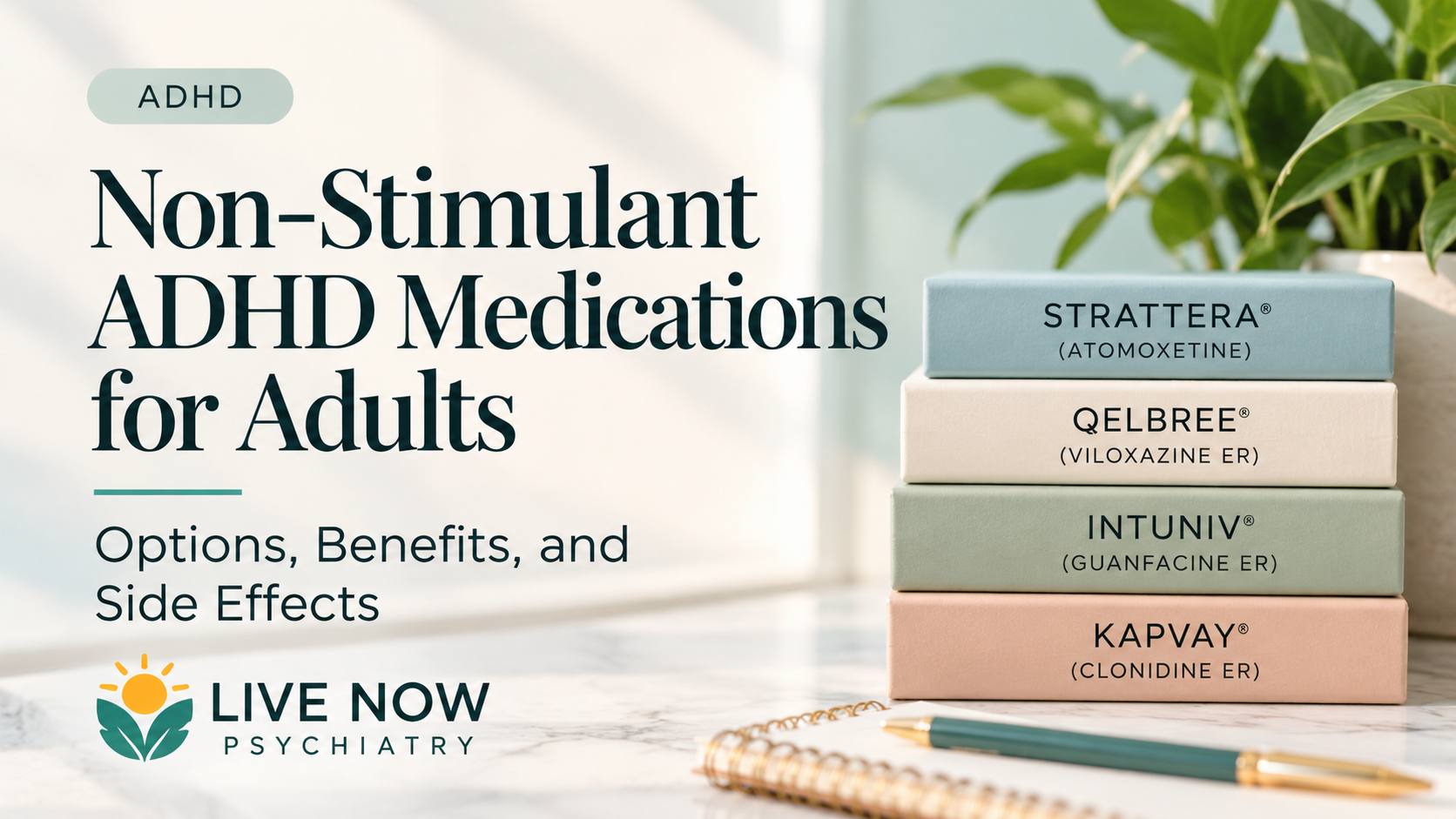
Non-Stimulant ADHD Medications for Adults: Options, Benefits, and Side Effects
Medically Reviewed by Rebecca Sommer, MSN, APRN, PMHNP-BC, FNP-C Last Medically Reviewed: October 11, 2026Non-stimulant medications can be an important treatment option for adults with attention-deficit/hyperactivity disorder (ADHD).
While stimulant medications are commonly used for ADHD, they are not the only option. Some adults may benefit from a non-stimulant because of side effects, medical history, personal preference, co-occurring conditions, concerns about stimulant misuse, or an inadequate response to previous treatment.
At Live Now Psychiatry, Florida adults can receive online ADHD evaluations and treatment through secure telehealth appointments.
This guide explains the main non-stimulant ADHD medications used in adults, how they work, potential benefits, common side effects, and what patients should discuss with their healthcare provider when considering treatment.
Adults 18+ • Florida only • Secure telehealth • Self-pay psychiatric care
What Are Non-Stimulant ADHD Medications?
Non-stimulant ADHD medications are prescription medications that may help reduce ADHD symptoms without belonging to the traditional stimulant medication class.
They may be considered when:
Stimulants cause problematic side effects
Stimulants are not sufficiently effective
A patient prefers a non-stimulant treatment approach
Medical or psychiatric history affects stimulant suitability
Substance-use concerns are relevant
A clinician believes a non-stimulant may better fit the patient's treatment needs
Non-stimulants generally work differently from amphetamine- or methylphenidate-based medications and often take longer to produce their full therapeutic effect.
They should still be prescribed and monitored carefully.
If you are comparing the full range of treatment choices, read Adult ADHD Treatment in Florida: Online Evaluation & Medication Management.
What Non-Stimulant Medications Are Used for Adult ADHD?
The main medications adults may hear about include:
Atomoxetine
Viloxazine extended-release
Guanfacine extended-release
Clonidine extended-release
Certain medications used off-label in selected patients
Not every medication listed here is FDA-approved for adult ADHD specifically.
That distinction matters.
For example, atomoxetine is approved for ADHD in adults, while some alpha-2 adrenergic agonists have FDA approval primarily in pediatric populations and may be considered off-label in adults in certain clinical situations.
Medication choice should be individualized.
Atomoxetine (Strattera)
Atomoxetine is one of the best-known non-stimulant medications for ADHD.
Strattera is the former brand name, while atomoxetine is the generic medication.
It is a selective norepinephrine reuptake inhibitor and is FDA-approved for ADHD in adults and children.
How Atomoxetine Works
Atomoxetine primarily increases the availability of norepinephrine in the brain.
Norepinephrine is involved in:
Attention
Alertness
Impulse control
Behavioral regulation
Executive functioning
Unlike stimulant medications, atomoxetine does not typically produce an immediate noticeable effect after each dose.
Its benefit may develop gradually over time.
Potential Benefits of Atomoxetine
Potential advantages may include:
Non-stimulant treatment
Not a Schedule II controlled substance
No stimulant-type misuse potential
May provide all-day symptom coverage when effective
Can be useful for adults who do not tolerate stimulants
May be considered when stimulant treatment is not preferred or appropriate
Common Side Effects of Atomoxetine
Potential side effects may include:
Nausea
Decreased appetite
Dry mouth
Constipation
Fatigue
Dizziness
Sleep changes
Increased sweating
Sexual side effects
Urinary symptoms
Increased blood pressure or heart rate
For a deeper explanation, read Strattera for Adult ADHD: How It Works, Side Effects, and What to Expect.
Viloxazine Extended-Release
Viloxazine extended-release is another non-stimulant medication used for ADHD.
It is marketed under the brand name Qelbree.
Viloxazine affects norepinephrine-related signaling and has additional effects on certain serotonin receptors.
It was first approved for pediatric ADHD and later received FDA approval for use in adults with ADHD.
Potential Benefits of Viloxazine
Potential advantages may include:
Non-stimulant treatment
Not classified as a Schedule II controlled substance
Once-daily dosing
Option for patients who cannot tolerate or do not want stimulant medication
Possible Side Effects
Potential side effects may include:
Sleepiness
Fatigue
Nausea
Decreased appetite
Insomnia
Headache
Irritability
Increased heart rate
Increased blood pressure
Viloxazine also has important warnings and interaction considerations, including effects involving certain liver enzymes that can change levels of other medications.
Patients should provide their clinician with a complete medication list before starting treatment.
Guanfacine Extended-Release
Guanfacine extended-release is another non-stimulant medication associated with ADHD treatment.
It is an alpha-2A adrenergic receptor agonist.
Guanfacine extended-release is FDA-approved for ADHD in children and adolescents, but clinicians may sometimes consider it off-label for adults.
How Guanfacine Works
Guanfacine affects alpha-2A adrenergic receptors in areas of the brain involved in:
Attention
Working memory
Behavioral regulation
Impulse control
Potential Benefits
Depending on the patient, potential advantages may include:
Non-stimulant treatment
No Schedule II controlled-substance status
May be considered when hyperactivity, impulsivity, or sleep-related concerns are relevant
May be considered when stimulant treatment is not tolerated
Possible Side Effects
Potential side effects include:
Sleepiness
Fatigue
Dizziness
Low blood pressure
Slower heart rate
Dry mouth
Constipation
Because guanfacine can lower blood pressure and heart rate, patients should not stop it abruptly without guidance from a clinician.
Sudden discontinuation may cause rebound increases in blood pressure.
Clonidine Extended-Release
Clonidine extended-release is another alpha-2 adrenergic agonist used in ADHD treatment.
Like guanfacine, its FDA approval for ADHD is primarily in pediatric patients, though it may sometimes be considered off-label in adults.
Potential Benefits
Potential reasons a clinician may consider clonidine include:
Non-stimulant approach
Hyperactivity or impulsivity concerns
Difficulty tolerating stimulant medication
Sleep-related symptoms in selected patients
Need for an alternative treatment strategy
Possible Side Effects
Potential side effects may include:
Drowsiness
Fatigue
Dizziness
Low blood pressure
Slow heart rate
Dry mouth
Constipation
Clonidine also should not be stopped abruptly without medical supervision because of the risk of rebound hypertension.
Are Antidepressants Used for ADHD?
Certain antidepressants may sometimes be prescribed off-label for ADHD.
One example is bupropion.
Bupropion is not FDA-approved specifically for ADHD, but some clinicians may consider it in selected adults, particularly when ADHD occurs with depression or when other medication options are not appropriate.
Potential Benefits of Bupropion
Possible reasons it may be discussed include:
ADHD symptoms plus depression
Desire to avoid stimulant treatment
Previous intolerance to another medication
Need for an alternative off-label option
Possible Side Effects
Potential side effects may include:
Insomnia
Dry mouth
Headache
Nausea
Anxiety
Reduced appetite
Increased blood pressure
Bupropion also lowers seizure threshold and may not be appropriate for people with certain seizure disorders or eating-disorder histories.
Off-label medication use should always be discussed clearly with the patient.
Comparing Non-Stimulant ADHD Medications for Adults
Non-stimulant ADHD medications differ in their FDA-approved uses, potential side effects, and effects on blood pressure and heart rate. Understanding these differences can help adults make informed treatment decisions with their healthcare provider.
Atomoxetine (Strattera)
FDA-approved for adult ADHD: Yes.
Atomoxetine is a selective norepinephrine reuptake inhibitor approved for ADHD treatment in children, adolescents, and adults.
Common side effects may include nausea, decreased appetite, dry mouth, constipation, and insomnia. Atomoxetine may increase blood pressure and heart rate and requires appropriate cardiovascular monitoring.
Viloxazine Extended-Release (Qelbree)
FDA-approved for adult ADHD: Yes.
Viloxazine ER is a non-stimulant medication approved for ADHD treatment in adults and pediatric patients ages 6 years and older.
Potential side effects include insomnia, fatigue, nausea, headache, and decreased appetite. Qelbree carries an FDA boxed warning regarding suicidal thoughts and behaviors and has important drug interaction considerations.
Guanfacine Extended-Release (Intuniv)
FDA-approved for adult ADHD: No. Off-label use in adults.
Guanfacine ER is an alpha-2A adrenergic receptor agonist FDA-approved for ADHD treatment in children and adolescents ages 6–17. It may sometimes be prescribed off-label for adults based on individual clinical circumstances.
Common side effects include sleepiness, fatigue, dizziness, and decreased blood pressure or heart rate. Abrupt discontinuation may cause rebound hypertension.
Clonidine Extended-Release (Kapvay)
FDA-approved for adult ADHD: No. Off-label use in adults.
Clonidine ER is an alpha-2 adrenergic agonist FDA-approved for ADHD treatment in pediatric patients ages 6–17. Its use for adult ADHD is considered off-label.
Potential side effects include drowsiness, fatigue, dizziness, low blood pressure, and a slower heart rate. Abrupt discontinuation may result in rebound hypertension.
Important: FDA-approved medications are not necessarily approved for ADHD treatment in every age group. Off-label prescribing may be considered when clinically appropriate, but treatment decisions should always account for individual medical history, potential medication interactions, and safety considerations.
Non-Stimulant vs. Stimulant ADHD Medication
Non-stimulants and stimulants can both be used to treat ADHD, but they differ in important ways.
Non-Stimulant ADHD Medications
Usually do not produce immediate effects
May take days or weeks to reach full benefit
Are generally not Schedule II controlled substances
May have less misuse potential
Can be useful when stimulants cause side effects
May be considered when substance-use concerns are present
Still require monitoring for side effects and effectiveness
Stimulant ADHD Medications
Often work more quickly
Include amphetamine and methylphenidate medications
Are Schedule II controlled substances
Carry risks of misuse, abuse, addiction, and diversion
Can cause appetite suppression, insomnia, and cardiovascular effects
Often require regular monitoring
Neither category is automatically better.
The most appropriate treatment depends on the individual.
Comparing Non-Stimulant ADHD Medications for Adults
Non-stimulant ADHD medications differ in their FDA-approved uses, potential side effects, and effects on blood pressure and heart rate. Understanding these differences can help adults make informed treatment decisions with their healthcare provider.
Atomoxetine (Strattera)
FDA-approved for adult ADHD: Yes.
Atomoxetine is a selective norepinephrine reuptake inhibitor approved for ADHD treatment in children, adolescents, and adults.
Common side effects may include nausea, decreased appetite, dry mouth, constipation, and insomnia. Atomoxetine may increase blood pressure and heart rate and requires appropriate cardiovascular monitoring.
Viloxazine Extended-Release (Qelbree)
FDA-approved for adult ADHD: Yes.
Viloxazine ER is a non-stimulant medication approved for ADHD treatment in adults and pediatric patients ages 6 years and older.
Potential side effects include insomnia, fatigue, nausea, headache, and decreased appetite. Qelbree carries an FDA boxed warning regarding suicidal thoughts and behaviors and has important drug interaction considerations.
Guanfacine Extended-Release (Intuniv)
FDA-approved for adult ADHD: No. Off-label use in adults.
Guanfacine ER is an alpha-2A adrenergic receptor agonist FDA-approved for ADHD treatment in children and adolescents ages 6–17. It may sometimes be prescribed off-label for adults based on individual clinical circumstances.
Common side effects include sleepiness, fatigue, dizziness, and decreased blood pressure or heart rate. Abrupt discontinuation may cause rebound hypertension.
Clonidine Extended-Release (Kapvay)
FDA-approved for adult ADHD: No. Off-label use in adults.
Clonidine ER is an alpha-2 adrenergic agonist FDA-approved for ADHD treatment in pediatric patients ages 6–17. Its use for adult ADHD is considered off-label.
Potential side effects include drowsiness, fatigue, dizziness, low blood pressure, and a slower heart rate. Abrupt discontinuation may result in rebound hypertension.
Important: FDA-approved medications are not necessarily approved for ADHD treatment in every age group. Off-label prescribing may be considered when clinically appropriate, but treatment decisions should always account for individual medical history, potential medication interactions, and safety considerations.
When Might a Non-Stimulant Be Considered Instead of a Stimulant?
Non-stimulant ADHD medications may be considered for adults who experience intolerable stimulant side effects, have certain contraindications, prefer an alternative to controlled-substance medications, or have other clinical circumstances that make non-stimulant treatment appropriate.
Stimulant medications such as Adderall and Vyvanse can be effective for many adults with ADHD. However, some individuals experience increased heart rate, elevated blood pressure, appetite suppression, insomnia, or other adverse effects.
Non-stimulant medications offer additional treatment options, although they are not free of risks or side effects. Atomoxetine and viloxazine ER may increase blood pressure or heart rate, while guanfacine ER and clonidine ER may lower them.
Non-stimulant medications also differ in how quickly their benefits become apparent. Some may require several weeks to evaluate their effectiveness.
The decision to prescribe a stimulant or non-stimulant should be individualized following a comprehensive psychiatric evaluation, review of medical history, and discussion of potential benefits, risks, and alternatives.
Explore Online ADHD Treatment in Florida
Choosing an ADHD medication involves more than comparing potential benefits and side effects. A comprehensive evaluation can help determine which treatment options may be appropriate based on symptoms, medical history, and individual needs.
At Live Now Psychiatry, Rebecca Sommer, MSN, APRN, PMHNP-BC, FNP-C, provides individualized online ADHD evaluations and medication management for adults throughout Florida.
Learn more about our Adult ADHD Treatment in Florida services.
How Long Do Non-Stimulant ADHD Medications Take to Work?
This varies by medication.
In general, non-stimulants usually do not work as quickly as stimulant ADHD medications.
Some patients may notice early improvement within days, but full therapeutic benefit may take several weeks depending on the medication and the individual.
Because of this slower onset, it is important to evaluate treatment over an appropriate period unless side effects or safety concerns require earlier changes.
Patients should not assume a medication has failed after only a few doses.
Follow-up with the prescribing clinician is important.
What Do Non-Stimulant ADHD Medications Feel Like?
There is no single feeling that proves a non-stimulant medication is working.
For many adults, improvement may be noticed through better functioning rather than a sudden subjective effect.
For example:
Tasks are easier to start
Fewer responsibilities are forgotten
Distractibility decreases
Work feels more manageable
Organization improves
Impulsivity decreases
Conversations are easier to follow
Projects are completed more consistently
A useful question is:
Am I functioning better in the areas where ADHD was interfering with my life?
That is often more meaningful than asking whether the medication feels noticeable.
What Are the Benefits of Non-Stimulant ADHD Medications?
Potential benefits may include:
Alternative for patients who cannot tolerate stimulants
Lower misuse potential
No Schedule II classification for most non-stimulant options
Potentially more consistent symptom coverage in some patients
Option for people with certain medical or psychiatric considerations
Useful when stimulant side effects outweigh benefits
May fit patient preference better
However, non-stimulants also have limitations.
They may:
Take longer to work
Be less effective for some patients
Cause sedation or fatigue
Affect blood pressure or heart rate
Have medication interaction concerns
Produce gastrointestinal or sexual side effects depending on the drug
The benefits and risks should be reviewed individually.
What Are the Most Common Side Effects of Non-Stimulant ADHD Medications?
Side effects vary by medication, but may include:
Fatigue
Drowsiness
Dizziness
Nausea
Decreased appetite
Dry mouth
Constipation
Sleep changes
Headache
Blood pressure changes
Heart rate changes
Sexual side effects
Irritability
Some non-stimulants may raise blood pressure.
Others may lower it.
This is one reason medication choice and monitoring should be individualized.
Can Non-Stimulant ADHD Medication Cause Fatigue?
Yes.
Fatigue and drowsiness can occur with several non-stimulant medications.
For example:
Atomoxetine can cause tiredness in some patients
Viloxazine can cause sleepiness or fatigue
Guanfacine can be sedating
Clonidine can be sedating
Patients should use caution with driving or operating machinery until they know how a medication affects them.
If fatigue becomes severe or interferes with functioning, discuss it with the prescribing clinician.
Can Non-Stimulants Affect Blood Pressure or Heart Rate?
Yes.
Different medications can have different cardiovascular effects.
Atomoxetine
May increase:
Blood pressure
Heart rate
Viloxazine
May increase:
Heart rate
Blood pressure
Guanfacine
May decrease:
Blood pressure
Heart rate
Clonidine
May decrease:
Blood pressure
Heart rate
This means cardiovascular history still matters even when a medication is not a stimulant.
A clinician may review:
Blood pressure
Heart rate
Personal heart history
Fainting history
Current medications
Other medical conditions
Are Non-Stimulant ADHD Medications Safer Than Stimulants?
Not automatically.
Non-stimulant does not mean risk-free.
Every medication has:
Potential side effects
Contraindications
Drug interactions
Monitoring requirements
Individual risks
A non-stimulant may be safer or more appropriate for a particular patient, while a stimulant may be safe and effective for someone else.
The decision depends on the entire clinical picture.
Who Might Consider a Non-Stimulant ADHD Medication?
A clinician and patient may discuss non-stimulant treatment when:
Stimulants caused significant side effects
Stimulants worsened sleep
Stimulants worsened anxiety
Stimulants caused unacceptable appetite suppression
A stimulant did not provide adequate symptom control
Substance-use history is relevant
Medical history affects stimulant use
The patient prefers a non-stimulant
The clinician believes another approach is more appropriate
There is no universal checklist that determines who should receive one.
Can Non-Stimulant ADHD Medications Help Anxiety?
Possibly, but this depends on the individual medication and the reason for the anxiety.
ADHD and anxiety often overlap.
Symptoms such as:
Difficulty concentrating
Restlessness
Overthinking
Sleep problems
Feeling overwhelmed
Trouble completing tasks
may occur in either condition.
Some adults experience anxiety because untreated ADHD creates repeated problems with deadlines, disorganization, or responsibilities.
Others have a primary anxiety disorder that independently affects concentration.
If you are unsure which condition may be contributing to your symptoms, read ADHD vs. Anxiety: How to Tell the Difference.
Can Non-Stimulant ADHD Medications Help With Sleep?
Some may be more sedating than stimulants, but they should not be considered sleep medications automatically.
Guanfacine and clonidine can cause drowsiness.
Atomoxetine and viloxazine can also affect sleep, but some patients may experience insomnia instead.
Sleep effects vary considerably.
If chronic insomnia is present, it should be evaluated separately.
Learn more about insomnia treatment in Florida (link to your Insomnia Treatment page).
Are Non-Stimulant ADHD Medications Addictive?
Most non-stimulant ADHD medications are not classified as Schedule II controlled substances and do not carry the same misuse and addiction risks as prescription stimulants.
That is one reason some patients and clinicians may prefer them.
However, medications should still:
Be taken only as prescribed
Never be shared
Be stored safely
Be monitored appropriately
No prescription medication should be treated casually simply because it is not controlled.
What Should You Tell Your Provider Before Starting a Non-Stimulant?
Before starting any ADHD medication, provide a complete medical and psychiatric history.
Tell your provider about:
Current prescription medications
Over-the-counter medications
Vitamins
Supplements
Allergies
Heart disease
Blood pressure problems
Abnormal heart rhythms
Fainting
Liver disease
Kidney disease
Seizure history
Glaucoma
Depression
Bipolar disorder
Suicidal thoughts or history
Substance-use history
Previous ADHD medications
Previous medication reactions
Pregnancy
Plans for pregnancy
Breastfeeding
Medication interactions are especially important.
For example, atomoxetine has clinically important interactions with MAO inhibitors.
Viloxazine can affect metabolism of other medications.
A complete medication list helps reduce avoidable risk.
Non-Stimulant ADHD Medications and Pregnancy
Patients who are pregnant, may be pregnant, are planning pregnancy, or are breastfeeding should discuss medication treatment with their healthcare provider.
Different non-stimulant medications have different pregnancy and lactation considerations.
The decision to continue, stop, or change medication should be individualized.
Do not make medication changes based solely on information found online.
Contact your prescriber if pregnancy occurs while taking psychiatric medication.
Are There Serious Side Effects?
Serious reactions depend on the specific medication.
Patients should seek prompt medical attention for symptoms such as:
Chest pain
Significant shortness of breath
Fainting
Severe allergic reaction
Seizure
Hallucinations
Severe mood or behavioral changes
Suicidal thoughts
Yellowing of the skin or eyes
Severe or rapidly worsening symptoms
Some medications also carry specific warnings related to suicidal thoughts in younger populations.
Any suicidal thoughts or psychiatric emergency require prompt professional evaluation.
Call 911 or go to the nearest emergency department for an immediate emergency.
How Do You Know If a Non-Stimulant Is Working?
Treatment should be evaluated based on function.
A provider may ask whether there has been improvement in:
Attention
Organization
Task initiation
Task completion
Distractibility
Impulse control
Work performance
School functioning
Household responsibilities
Relationships
Side effects should also be weighed against benefit.
A medication that improves concentration but causes severe fatigue, dizziness, or other significant problems may not be the right long-term option.
Why ADHD Medication Follow-Up Matters
Non-stimulants still require follow-up.
A clinician may monitor:
ADHD symptoms
Functioning
Sleep
Appetite
Weight
Blood pressure
Heart rate
Mood
Anxiety
Side effects
Medication adherence
Medication interactions
New medical conditions
Treatment should be adjusted based on the patient's response rather than simply continued indefinitely without reassessment.
Adult ADHD Treatment Is More Than Medication
Difficulty concentrating does not automatically mean ADHD.
Symptoms that look like ADHD may also occur with:
Anxiety
Depression
Insomnia
Trauma-related symptoms
Substance use
Thyroid or other medical conditions
Medication effects
A comprehensive evaluation may consider:
Childhood symptoms
Current symptoms
Functional impairment
Work or school history
Relationship functioning
Medical history
Psychiatric history
Sleep
Substance use
Other possible causes of attention problems
Learn more about Adult ADHD Evaluation Online in Florida.
You may also find How to Know If You Have ADHD as an Adult helpful.
Online ADHD Treatment for Adults in Florida
Live Now Psychiatry provides online psychiatric care for adults throughout Florida through secure telehealth.
Adults experiencing problems with focus, organization, distractibility, impulsivity, or completing responsibilities can receive an evaluation to determine whether ADHD or another condition may be contributing.
When clinically appropriate, treatment may include:
Psychiatric evaluation
Medication management
Non-stimulant ADHD medication when appropriate
Stimulant medication when appropriate
Ongoing follow-up
Supportive therapy
Education about treatment options
An ADHD evaluation does not guarantee an ADHD diagnosis or prescription for atomoxetine, Qelbree, guanfacine, clonidine, stimulant medication, or any other specific medication.
Treatment recommendations are based on each patient's individual clinical assessment.
Learn more about online ADHD treatment in Florida.
Frequently Asked Questions About Non-Stimulant ADHD Medications
What Is the Most Common Non-Stimulant ADHD Medication for Adults?
Atomoxetine is one of the most established non-stimulant options and is FDA-approved for ADHD in adults.
Is Strattera a Non-Stimulant?
Yes.
Strattera is the former brand name for atomoxetine, a non-stimulant ADHD medication.
Is Qelbree a Non-Stimulant?
Yes.
Qelbree contains viloxazine extended-release and is a non-stimulant ADHD medication.
Is Guanfacine a Non-Stimulant?
Yes.
Guanfacine is not a stimulant. Extended-release guanfacine is FDA-approved for pediatric ADHD and may sometimes be considered off-label in adults.
Is Clonidine a Non-Stimulant?
Yes.
Clonidine is an alpha-2 adrenergic agonist and may sometimes be used as part of ADHD treatment.
Do Non-Stimulant ADHD Medications Work as Well as Stimulants?
Response varies.
Stimulants are highly effective for many patients, but some adults respond well to non-stimulants.
The best medication depends on the individual.
How Long Do Non-Stimulants Take to Work?
Many non-stimulants take longer than stimulants to produce their full effect.
Depending on the medication, improvement may develop over several days or weeks.
Can Non-Stimulants Cause Weight Loss?
Some can.
Atomoxetine and viloxazine may decrease appetite in some patients.
Can Non-Stimulants Make You Tired?
Yes.
Fatigue or drowsiness can occur with atomoxetine, viloxazine, guanfacine, and clonidine.
Are Non-Stimulants Controlled Substances?
Most commonly used non-stimulant ADHD medications are not Schedule II controlled substances.
Can Adults Get Non-Stimulant ADHD Medication Through Telepsychiatry in Florida?
A Florida-licensed healthcare professional may evaluate whether non-stimulant medication is appropriate through telehealth when clinically appropriate and permitted under applicable professional standards.
A telehealth appointment does not guarantee an ADHD diagnosis or prescription for a specific medication.
Resources
For additional evidence-based information:
Medical Disclaimer
The information in this article is provided for educational purposes only and is not intended to diagnose ADHD, recommend a specific medication, establish an individualized treatment plan, or replace medical advice from a qualified healthcare professional.
Non-stimulant ADHD medications have potential benefits, risks, contraindications, drug interactions, and monitoring requirements that vary by patient.
Some medications discussed in this article may be used off-label in adults. Off-label prescribing may be clinically appropriate in selected situations but should be discussed with a qualified healthcare professional.
Do not start, stop, increase, decrease, combine, or switch prescription medication without discussing the change with your prescribing healthcare professional.
Reading this article or visiting this website does not establish a provider-patient relationship with Live Now Psychiatry, LLC.
If you are experiencing a psychiatric or medical emergency, call 911 or go to the nearest emergency department.
Related Articles
About the Author
Rebecca Sommer, MSN, APRN, PMHNP-BC, FNP-C, is a dual-board-certified Psychiatric-Mental Health and Family Nurse Practitioner and founder of Live Now Psychiatry. She provides online psychiatric evaluations, ADHD treatment, medication management, and psychotherapy for adults throughout Florida. Her clinical background includes oncology and patient-centered healthcare.
Learn more about Rebecca Sommer's professional background and credentials.
Ready to Learn More About Adult ADHD Treatment?
If attention problems, disorganization, distractibility, impulsivity, or difficulty completing responsibilities are interfering with everyday life, an evaluation can help clarify what may be contributing and which treatment options may be appropriate.
Live Now Psychiatry provides self-pay online psychiatric care for adults throughout Florida through secure telehealth.
A screening or psychiatric evaluation does not guarantee acceptance into the practice, an ADHD diagnosis, or prescription for a non-stimulant, stimulant, controlled substance, or any other specific medication.