
By Rebecca Sommer, MSN, APRN, PMHNP-BC, FNP-C
Dual Board-Certified Psychiatric Mental Health and Family Nurse Practitioner
Founder, Live Now Psychiatry

You finish a conversation with a friend, coworker, or someone you're dating. Everything seemed fine. But a few hours later, your mind starts replaying what happened.
"Did I say something wrong?"
"Why did they respond that way?"
"Did I talk too much?"
"Maybe they think I'm annoying."
You begin analyzing their tone, facial expressions, and the exact words you used. You might even reread text messages looking for clues.
If this sounds familiar, you may wonder, "Why do I overthink conversations even when nothing bad happened?"
Overthinking conversations often involves repeatedly analyzing social interactions because of uncertainty, self-doubt, fear of negative evaluation, or a desire for reassurance.
This pattern may involve post-event processing, a term used in psychological research to describe repeatedly reviewing social experiences after they occur.
Although occasional reflection is normal, repeatedly replaying conversations can become emotionally exhausting when it increases distress without helping you reach a useful conclusion.
Is It Normal to Replay Conversations in Your Head?
Yes. Occasionally replaying conversations is common, especially after emotionally important or stressful interactions.
However, when you repeatedly analyze what you said, worry about how others perceive you, or struggle to stop thinking about past interactions, the pattern may be associated with rumination, anxiety, or fear of negative evaluation.
The important distinction is whether reflecting helps you learn or leaves you feeling increasingly distressed.
A 60-Second Exercise to Stop Replaying a Conversation
When you catch yourself repeatedly analyzing something you said, try asking yourself three questions:
1. What actually happened? Focus on observable facts rather than assumptions.
2. Do I have evidence that something went wrong? Consider whether you're interpreting uncertainty as rejection.
3. Is there anything useful I can do now? If not, gently redirect your attention to the present.
The goal is not to eliminate uncomfortable thoughts but to develop a more flexible response to them.
Why Do I Replay Conversations in My Head?
You may replay conversations because you're trying to understand how others perceived you, identify possible mistakes, or prevent future embarrassment.
The mind naturally reviews social experiences. This can help us learn and improve communication.
However, reflection becomes less helpful when it turns into repetitive speculation about what others might be thinking.
For example, noticing that you interrupted someone and deciding to listen more carefully next time can be constructive.
Spending hours wondering whether someone secretly dislikes you because of one comment is less likely to produce a useful outcome.
The key difference is whether your thinking helps you learn or keeps you trapped in uncertainty.
7 Reasons You May Overthink Conversations

1. You Worry About What Other People Think
Most people care about making a good impression.
However, when the fear of being judged becomes intense, even ordinary conversations can feel like situations in which you must perform perfectly.
You may analyze whether you appeared confident, intelligent, attractive, friendly, or interesting enough.
The more important another person's opinion feels, the more likely you may be to replay the interaction afterward.
2. You Struggle With Self-Doubt
Low confidence can influence how you interpret ambiguous social interactions.
If someone replies briefly, you may assume they're upset. If a friend takes longer than usual to respond, you might wonder whether you've done something wrong.
When you doubt your own judgment, you may look for hidden meanings in situations where there is not enough information to draw a conclusion.
3. You Expect Yourself to Communicate Perfectly
Some people believe they must always say the right thing.
They want every conversation to be interesting, thoughtful, appropriate, and free from mistakes.
However, real conversations are spontaneous and imperfect. People occasionally interrupt, misunderstand one another, forget words, or make awkward comments.
Expecting flawless communication can make ordinary social experiences feel unnecessarily stressful.
4. You Have Experienced Criticism or Rejection
Past experiences can shape expectations about future relationships.
If you've frequently been criticized, embarrassed, rejected, or misunderstood, you may become especially attentive to signs that another interaction could end badly.
This does not mean everyone who overthinks has experienced trauma.
However, previous interpersonal experiences can influence how safe or uncertain social situations feel.
5. You Frequently Seek Reassurance
You might repeatedly ask friends:
"Do you think I sounded rude?"
"Was that weird?"
"Do you think they're mad at me?"
Reassurance can provide temporary relief.
However, if you repeatedly need confirmation that a conversation went well, you may become increasingly dependent on other people to resolve uncertainty.
Learning to tolerate some uncertainty may be more helpful than trying to obtain absolute reassurance.
6. You May Experience Social Anxiety
Social anxiety disorder involves significant fear or anxiety about situations in which a person may be scrutinized or negatively evaluated by others.
Some individuals with social anxiety experience worry before an interaction and prolonged analysis afterward.
They may focus on perceived mistakes, signs of embarrassment, or concerns about how they appeared.
However, overthinking conversations alone does not mean you have social anxiety disorder.
A clinical evaluation considers symptom severity, duration, avoidance, distress, and impact on functioning.
7. You Have Difficulty Tolerating Uncertainty
You cannot know exactly what another person is thinking.
Even when a conversation seems positive, there may be small uncertainties about how your words were received.
For some people, uncertainty feels uncomfortable enough that they repeatedly analyze the situation in an attempt to reach certainty.
The difficulty is that replaying a conversation cannot reliably reveal another person's private thoughts.
Sometimes the most useful response is accepting that you do not have complete information.
What Is Post-Event Processing?
Post-event processing refers to repeatedly reviewing and evaluating a social interaction after it has occurred.
It is often discussed in research on social anxiety.
A person may focus on perceived mistakes, embarrassing moments, or assumptions about how others judged them.
For example, after a work meeting, you might repeatedly think about one sentence you said rather than considering the meeting as a whole.
You may remember your own nervousness and assume everyone else noticed it.
This kind of thinking can reinforce negative beliefs about social situations and increase worry about future interactions.
Importantly, remembering a conversation is not inherently unhealthy. The concern is when repetitive review increases distress or interferes with daily functioning.
What's the Difference Between Reflection and Rumination?
Reflection and rumination can look similar, but they serve different purposes.
Reflection helps you learn from an experience, focus on what you can change, and identify a constructive next step.
Rumination involves repeatedly focusing on perceived mistakes, uncertainty, or negative possibilities without reaching a useful resolution.
Example of reflection:
"I interrupted my coworker. Next time, I'll let them finish."
Example of rumination:
"I interrupted my coworker. They probably think I'm rude. Maybe everyone noticed. What if they don't want to work with me anymore?"
Reflection can support learning and personal growth.
Rumination may increase distress and reinforce self-doubt without helping you move forward.
Why Do I Overthink Text Messages?
Text messages can create additional uncertainty because they often lack tone of voice, facial expressions, and immediate feedback.
A short reply might mean someone is busy, distracted, tired, or simply prefers brief messages.
However, when you're already worried about rejection, you may interpret the same message negatively.
Common behaviors include:
Rereading messages repeatedly
Analyzing punctuation or response length
Worrying about how quickly someone responds
Rewriting messages many times before sending them
Assuming a delayed reply means something is wrong
Seeking reassurance from friends about what a message means
The challenge is that a text message rarely provides enough information to know exactly what another person feels.
Learning to consider multiple explanations rather than immediately assuming the worst can help reduce unnecessary distress.
Why Do I Overthink Conversations With Someone I'm Dating?

Dating can involve uncertainty, vulnerability, and concerns about acceptance or rejection.
When you're interested in someone, their opinion may feel especially important.
You might replay conversations to determine whether they enjoyed spending time with you, whether you said something awkward, or whether their behavior suggests romantic interest.
You may also overanalyze text messages, response times, or changes in communication.
Although reflecting on interactions can be useful, repeatedly searching for hidden meanings may increase anxiety rather than provide clarity.
Rather than trying to interpret every detail, it may be more helpful to observe consistent patterns of communication and behavior over time.
Healthy relationships involve openness, mutual respect, and the ability to communicate directly when concerns arise.
How Can Overthinking Affect Relationships?
Repeatedly analyzing conversations can affect relationships in several ways.
You may become hesitant to express your needs because you're afraid of saying the wrong thing.
You might apologize excessively, seek repeated reassurance, or avoid difficult conversations.
In dating relationships, you may become preoccupied with interpreting every interaction rather than allowing the relationship to develop naturally.
At work, you may spend considerable time worrying about how colleagues perceived your comments.
Over time, these patterns can interfere with confidence, communication, and emotional well-being.
You may also find Adult ADHD and Relationships: How Symptoms Can Affect Communication and Connection helpful.
How to Stop Overthinking Conversations: 7 Practical Strategies
1. Identify When You're Replaying Instead of Problem-Solving
Ask yourself:
"Am I learning something useful, or am I repeating the same question?"
If you have already considered the situation and cannot identify a constructive next step, continuing to analyze it may not help.
2. Separate Facts From Assumptions
Consider the difference between what happened and what you're imagining.
Fact: Your friend responded with a short message.
Assumption: Your friend is upset with you.
A brief response does not necessarily mean something is wrong.
Practicing this distinction can help reduce unnecessary worry.
3. Challenge Mind-Reading
Mind-reading is a common cognitive distortion in which someone assumes they know what another person is thinking without sufficient evidence.
For example:
"They probably think I'm boring."
Instead, consider:
"I don't know what they thought. There are several possible explanations, and I don't need to decide that the worst one is true."
The goal is not to force positive thinking. It is to develop a more balanced interpretation.
4. Reduce Reassurance-Seeking
If you frequently ask other people to evaluate your conversations, try noticing when the urge appears.
Before asking for reassurance, consider whether the answer would help you make a decision or simply provide temporary relief.
You can gradually practice allowing some uncertainty to remain unresolved.
5. Redirect Your Attention to the Present
When you notice yourself mentally replaying a conversation, gently return your attention to what you're doing.
You might focus on your surroundings, engage in an activity, or redirect your attention to a meaningful task.
The goal is not to suppress thoughts completely.
Instead, it is to avoid giving every repetitive thought unlimited attention.
6. Practice More Flexible Communication Expectations
You do not need to communicate perfectly to have healthy relationships.
Most conversations contain small pauses, misunderstandings, and imperfect wording.
Try allowing yourself to be genuine rather than constantly monitoring how you appear.
7. Consider Therapy When Overthinking Becomes Distressing
If you spend significant time replaying conversations, avoid social situations, or experience persistent anxiety about how others perceive you, professional support may help.
Therapy can provide tools for examining self-critical thoughts, reducing unhelpful behavioral patterns, and improving confidence.
Can Therapy Help With Rumination and Social Self-Doubt?
Psychotherapy may help individuals understand why they repeatedly analyze social interactions and develop healthier ways of responding.
Cognitive behavioral therapy (CBT) can help identify patterns such as mind-reading, catastrophizing, and negative self-evaluation.
Acceptance and commitment therapy (ACT) may help patients respond more flexibly to uncertainty and uncomfortable thoughts.
Supportive psychotherapy can also help patients explore relationship concerns, confidence, communication patterns, and emotional stressors.
Treatment should be tailored to individual symptoms, goals, and clinical needs.
Learn more about online therapy in Florida.
When Should You Seek Professional Help for Overthinking?
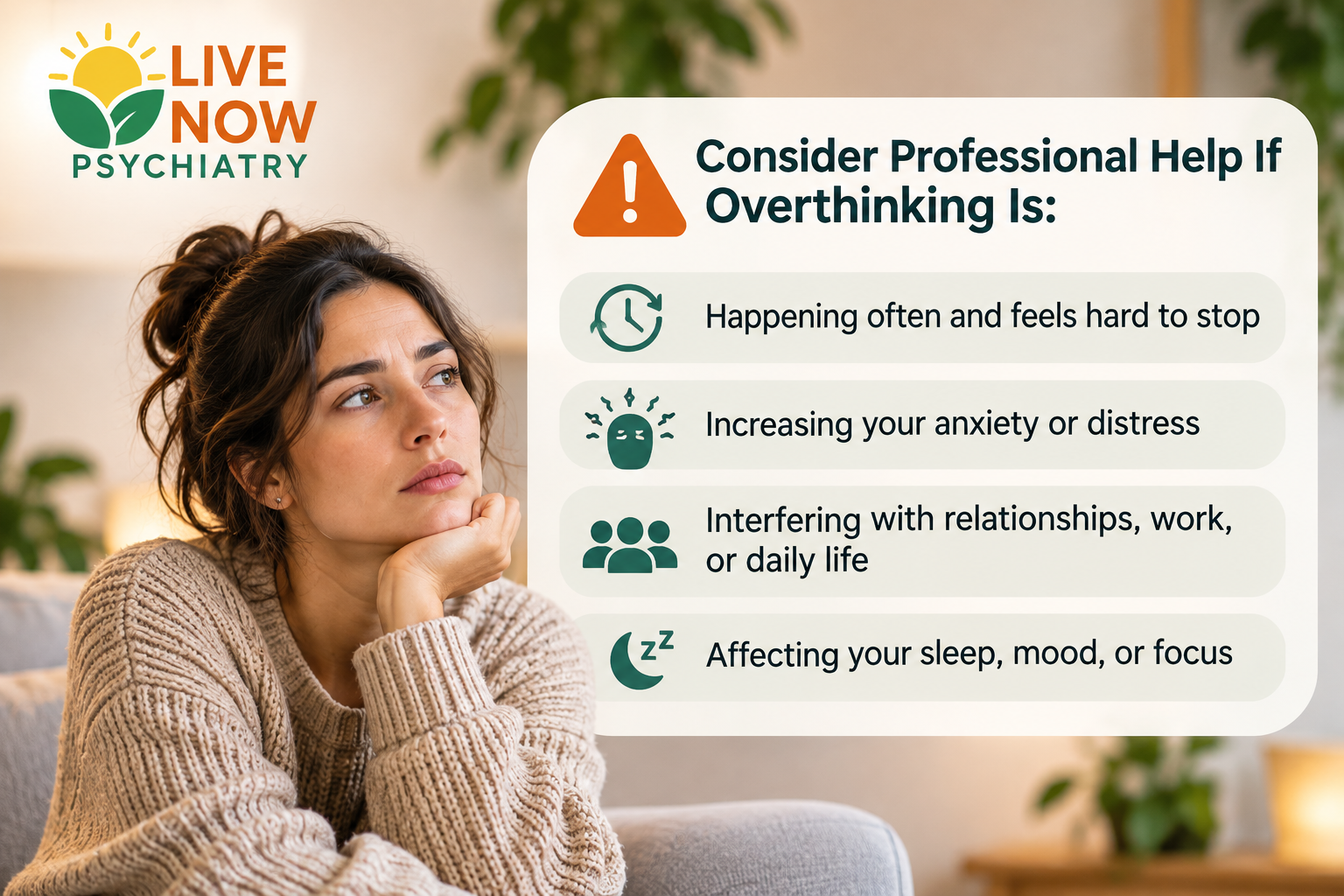
Consider speaking with a mental health professional if:
You spend significant time replaying conversations.
You avoid social interactions because you're afraid of embarrassment.
You frequently seek reassurance about what others think.
You experience persistent anxiety before or after conversations.
Your relationships or work are affected by self-doubt.
Repetitive thoughts interfere with sleep or daily activities.
A clinical evaluation can help determine whether these experiences are related to anxiety, stress, or another concern.
Frequently Asked Questions About Overthinking Conversations
Is overthinking conversations a sign of anxiety?
Overthinking conversations can be associated with anxiety, particularly social anxiety and fear of negative evaluation. However, repeatedly analyzing conversations does not necessarily mean you have an anxiety disorder. A clinical evaluation can help determine whether your symptoms are related to anxiety, stress, or another concern.
Why do I keep thinking about embarrassing things I've said?
You may repeatedly think about embarrassing conversations because your mind is trying to understand what happened, prevent future mistakes, or determine how others perceived you. This pattern is sometimes called post-event processing. When these thoughts become repetitive and distressing, they may contribute to rumination and self-doubt.
Is replaying conversations a symptom of ADHD?
Some adults with ADHD experience difficulties with emotional regulation, impulsivity, or social interactions that may contribute to replaying conversations. However, repeatedly analyzing conversations is not a diagnostic criterion for ADHD and can also occur with anxiety or other concerns. An individualized evaluation is necessary to determine whether ADHD is present.
Can therapy help me stop overthinking?
Yes. Psychotherapy can help individuals recognize unhelpful thinking patterns, manage anxiety, and develop healthier responses to uncertainty. Cognitive behavioral therapy (CBT) may help address negative assumptions and excessive self-criticism, while acceptance and commitment therapy (ACT) can help individuals respond more flexibly to repetitive thoughts.
When should I seek professional help for overthinking?
Consider seeking professional help when repetitive thoughts interfere with your sleep, relationships, work, social activities, or daily functioning. If overthinking causes persistent distress, anxiety, or avoidance, a mental health professional can evaluate your symptoms and discuss appropriate treatment options.
A screening helps determine whether the practice may be an appropriate fit. It is not a psychiatric evaluation and does not guarantee acceptance or treatment.
Online Therapy for Overthinking and Anxiety in Florida

If persistent overthinking, self-doubt, or anxiety is affecting your relationships, sleep, or daily life, professional support may help.
At Live Now Psychiatry, Rebecca Sommer, MSN, APRN, PMHNP-BC, FNP-C, provides personalized online psychiatric care and psychotherapy for eligible adults ages 18 and older throughout Florida.
Treatment is individualized based on each patient's symptoms, goals, and clinical needs.
A screening call helps determine whether Live Now Psychiatry may be an appropriate fit. It is not a psychiatric evaluation, does not establish a patient-provider relationship, and does not guarantee acceptance into the practice or treatment.
About the Author
Rebecca Sommer, MSN, APRN, PMHNP-BC, FNP-C, is a dual board-certified Psychiatric Mental Health and Family Nurse Practitioner and founder of Live Now Psychiatry.
With more than 15 years of healthcare experience, she provides individualized telehealth psychiatric care for eligible adults ages 18 and older throughout Florida.
Learn more about Rebecca Sommer.
Medical Disclaimer
This article is for educational and informational purposes only and does not replace individualized medical or psychiatric evaluation, diagnosis, or treatment.
Reading this article, submitting a screening request, or participating in a screening call does not establish a patient-provider relationship with Live Now Psychiatry.
Live Now Psychiatry is not an emergency or crisis service.
If you are experiencing an immediate medical or psychiatric emergency, including suicidal thoughts, homicidal thoughts, or other life-threatening symptoms, call 911 or go to the nearest emergency department immediately.
In the United States, you may also call or text 988 for suicide and crisis support.